

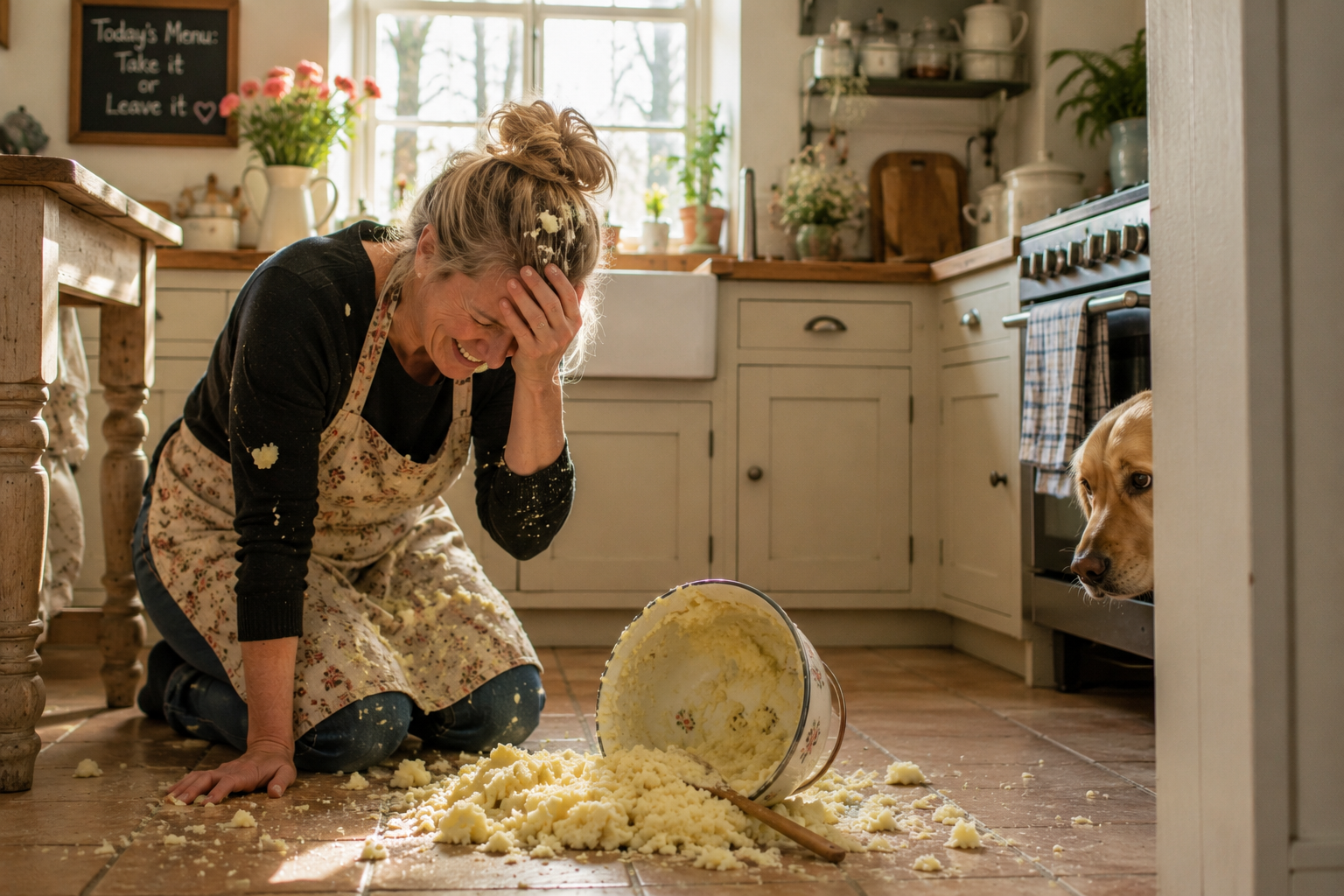
There are moments in life that are so absurd you can’t help but laugh at yourself afterwards, although that laughter usually arrives a little later than you’d like. Then all of a sudden you realise that emotional healing is weird. Mine happened standing barefoot in my kitchen, peering into the fridge with all the optimism of someone who’d been looking forward to lunch since about nine o’clock that morning. The previous evening I’d made a lasagne that had turned out particularly well. You know the sort—the kind that somehow tastes even better the next day once all the flavours have settled down and become friends. Before going to bed, I’d carefully packed myself a generous portion into a plastic container, mentally congratulating my organised self for thinking ahead.
The next day had been busy, I’d skipped my mid-morning snack because I was “saving myself” for that lasagne and by lunchtime I could practically taste it. I opened the fridge, reached confidently for the container and smiled. Then I lifted the lid. Empty. Completely, spectacularly empty. Whoever had enjoyed my lunch had also thoughtfully returned the container to the fridge as though this was perfectly acceptable behaviour. I stood there blinking at it for a moment, wondering whether I’d somehow imagined the entire thing. Then, to my absolute horror, I burst into tears.
Not delicate little tears that could be brushed away before anyone noticed. Proper, shoulder-shaking, “what on earth is wrong with me?” tears. If a television crew had wandered into my kitchen at that precise moment, they could easily have mistaken the scene for some terrible family tragedy. In reality, somebody had simply eaten my leftovers.
Looking back now, I can honestly laugh about it because it was so wonderfully ridiculous. I wasn’t mourning a lasagne. I wasn’t emotionally attached to a plastic container. Yet there I was, crying as though someone had announced the end of civilisation. Once I’d calmed down, made myself a rather uninspiring cheese sandwich and regained a little perspective, I realised that the tears had very little to do with pasta. The empty container had simply become the final straw, the tiny thing that tipped over a pile of emotions I’d been carrying so quietly that even I hadn’t realised how heavy they had become.
I think that’s one of the strangest things about emotional healing. We imagine it should look graceful. We picture ourselves slowly becoming calmer, wiser and completely unfazed by life’s little inconveniences. Somewhere along the way we’ve absorbed the idea that healing is a destination we eventually arrive at, where we collect our emotional luggage, thank everyone for travelling with us and never cry over anything silly ever again.
It sounds wonderfully tidy, doesn’t it? Sadly, life has never shown much interest in being tidy. Instead, healing has a mischievous sense of humour. One day you feel beautifully centred. You answer difficult emails without your pulse racing, you smile politely at awkward relatives and you even manage to ignore that person in the supermarket who parks their trolley diagonally across the aisle as though they’re establishing a new country.
You start to think, “I’ve got this.” Then the next day somebody finishes the last biscuit, your internet stops working halfway through something important or you discover there’s no milk for your afternoon tea and suddenly you’re questioning every life choice you’ve made since secondary school.
I’ve spoken to enough friends over the years to know I’m far from the only person who’s experienced this peculiar phenomenon. One confessed that she cried because her toast landed butter-side down on the kitchen floor. Another found herself sitting in the car park outside the supermarket in floods of tears because she’d forgotten her reusable shopping bags for what felt like the hundredth time. Another friend once admitted she became unexpectedly emotional after dropping an entire bowl of mashed potatoes just as the family arrived for Sunday lunch.
At first glance these stories are funny, and that’s exactly why we enjoy telling them once enough time has passed. We laugh because we recognise ourselves in them. We’ve all had those moments when our reaction seems wildly out of proportion to whatever actually happened. Yet beneath the humour sits something surprisingly gentle. Very rarely are we crying because of toast, potatoes or forgotten shopping bags. Those little incidents simply arrive at the precise moment when our emotional reserves are already running lower than we realised.
For a long time I used to see these moments as proof that I wasn’t coping very well. I’d berate myself for being oversensitive and promise that next time I’d “pull myself together”, whatever that was supposed to mean. It’s an expression so many of us grew up hearing that we almost accept it without question, as though emotions are loose threads we’re expected to gather neatly before anyone notices. Looking back now, I think I was asking far too much of myself.
Life has a habit of asking us to carry invisible things. We worry about ageing parents while smiling through conversations at work. We quietly wonder how grown-up children are really coping, even when they insist everything is fine. We juggle household budgets, family expectations, friendships, health concerns and the endless list of ordinary responsibilities that somehow keep multiplying overnight. Most of us carry these things remarkably well, but carrying them well doesn’t mean they aren’t heavy. Sometimes all it takes is one empty lunch container for the weight to make itself known.
What has surprised me most is how easily we overlook the progress we’ve already made because we’re watching for the wrong signs. We expect healing to announce itself with dramatic transformations, but more often it arrives disguised as ordinary Tuesday afternoons. We notice that we’re sleeping through the night more often than we used to. We stop replaying difficult conversations quite so many times before falling asleep. We become less interested in winning arguments and more interested in protecting our peace. We no longer feel responsible for solving every family disagreement or rescuing every unhappy person we meet.
These changes are so gradual that they almost slip past unnoticed, rather like watching children grow when you see them every day. Then one afternoon you find yourself standing in front of an empty fridge, crying over yesterday’s lasagne, and immediately assume you’ve gone backwards. Perhaps you haven’t. Perhaps that emotional release simply means you’ve finally reached a place where your heart feels safe enough to let go of something it has been holding for much longer than you realised.
The older I become, the more convinced I am that healing is one of the untidiest, most unpredictable experiences we ever go through. It doesn’t move politely from one stage to the next, ticking boxes as it goes. It loops back on itself, takes unexpected detours and occasionally stops to have a little cry over something completely insignificant before carrying on.
Oddly enough, that’s beginning to comfort me. If healing can include laughter, frustration, relief, unexpected tears and the occasional emotional attachment to leftover lasagne, perhaps we’re all doing far better than we think we are. The trick, I’ve come to believe, isn’t trying to become someone who never wobbles. It’s learning not to mistake every wobble for failure.
Sometimes the strongest people aren’t the ones who never cry over small things. They’re the ones who wipe their eyes, make another sandwich, have a quiet chuckle at themselves and realise that tomorrow will probably feel different again. And strangely enough, tomorrow usually does.
One of the most reassuring discoveries I’ve made is that our hearts have a habit of choosing curious moments to empty themselves. They don’t always wait for anniversaries or difficult conversations. They certainly don’t send us a polite diary invitation saying, “Wednesday at two o’clock would be a convenient time for an emotional release.”
Instead, they catch us completely off guard. You’re happily watering the garden when a particular song drifts over the neighbour’s fence. You’re folding towels straight from the washing line when you suddenly remember someone who used to help you peg them up. You’re standing in the queue at the supermarket watching an elderly couple decide which biscuits to buy and, for reasons you can’t quite explain, your eyes begin to sting. Nothing dramatic has happened. The world hasn’t changed in those few seconds. Something inside you has simply recognised a feeling that has been patiently waiting its turn.
I suspect that’s why so many of us become confused by healing. We imagine it should be logical, but emotions have never been especially interested in logic. If they were, we’d only cry when genuinely terrible things happened and we’d never find ourselves laughing until our sides hurt at the most inappropriate moments. We’d be able to schedule our feelings between grocery shopping and paying the electricity bill. Instead, our hearts seem to work on their own peculiar timetable, quietly sorting through memories, disappointments, hopes and worries while we get on with everyday life. Every now and then they tap us gently on the shoulder and remind us they’re still busy in there.
I used to think these unexpected emotional moments meant I was dwelling on the past too much. I’d wonder why I couldn’t simply leave certain experiences behind and move on like everyone else appeared to manage. The funny thing is, the older I get, the more convinced I become that everyone else is having exactly the same experience. We just don’t often talk about it. We chat about recipes, grandchildren, holidays, gardening and the weather, but very few people admit that they cried because the supermarket had stopped stocking their favourite yoghurt. Yet if we’re honest, it probably wasn’t the yoghurt at all. Perhaps it was the final inconvenience at the end of an exhausting week. Perhaps it reminded them of someone who always bought that particular brand. Perhaps they were simply tired in a way that sleep alone couldn’t fix.
I remember chatting to a friend over coffee who confessed she’d burst into tears because her husband had folded the towels “the wrong way”. We both laughed until we had tears in our eyes again, but as the laughter settled she quietly admitted she’d been caring for an elderly parent for months without allowing herself to stop. She’d been organising appointments, managing medication, reassuring worried family members and trying to keep life looking perfectly normal. The towels were never the problem. They simply arrived at the exact moment when her emotional reserves had been stretched as far as they could go. Looking back, she didn’t need someone to explain why she’d cried. She needed someone to reassure her that she wasn’t losing her mind.
I think we all need that reassurance from time to time.
There’s something incredibly comforting about discovering that being emotional doesn’t automatically mean you’re fragile. In fact, I’ve begun to think the opposite is often true. Some of the strongest people I know are the ones who occasionally dissolve into tears over seemingly insignificant things. Not because they’re weak, but because they’ve spent so much of their lives quietly holding everyone else together. They remember birthdays, organise family gatherings, keep emergency phone numbers, notice when someone sounds different on the telephone and somehow remember that one grandchild doesn’t like peas while another is allergic to strawberries. They carry emotional responsibility so naturally that they almost forget they’re carrying it at all. Eventually, something tiny nudges the stack just enough for a few feelings to tumble out.
Perhaps that’s why I no longer feel embarrassed by my “leftover lasagne moment”. If anything, it has become one of those stories I tell on myself because it reminds me how wonderfully human we all are. None of us glide through life in a permanent state of perfect emotional balance. We all have days when we feel capable of climbing mountains and others when finding matching socks feels like an unreasonable demand. The difference isn’t whether those days happen. The difference is how kindly we speak to ourselves when they do.
That has probably been one of the biggest changes in my own life. Years ago, my inner voice could be remarkably unforgiving. If I became upset, I’d immediately criticise myself. “You’re overreacting.” “Pull yourself together.” “Other people have real problems.” I doubt I’d ever have spoken to a friend that way, yet somehow I believed it was perfectly acceptable to speak to myself like that.
These days I try something rather different. When I notice myself becoming unexpectedly emotional, I pause for a moment and become curious instead of critical. I ask myself whether I’m actually upset about what’s happening right now or whether this little incident has simply uncovered something I’ve been carrying for longer than I realised. It’s surprising how often the answer has nothing to do with the situation in front of me.
Curiosity has turned out to be far kinder than criticism ever was. Sometimes I discover I’m simply exhausted. Sometimes I’ve been worrying about someone I love without admitting how much it’s affecting me. Occasionally I’ve been so busy looking after everyone else that I haven’t noticed I’ve quietly drifted to the bottom of my own priority list again.
Those realisations don’t magically solve everything, but they do soften the way I respond to myself. Instead of feeling ashamed for crying over something trivial, I can acknowledge that perhaps my heart was asking for a little attention before carrying on.
And isn’t that something we encourage in the people we love? If a close friend rang us in tears because she’d had a difficult week and then discovered someone had eaten the lunch she’d been looking forward to, most of us wouldn’t laugh at her or tell her she was being silly. We’d probably make her a cup of tea, offer her something to eat and gently remind her that she’s been under a lot of pressure lately. We’d instinctively understand that the missing lunch wasn’t the whole story. Somehow, though, extending that same kindness to ourselves can feel surprisingly difficult.
Perhaps that’s because we’re often so busy trying to appear as though we’re coping that we forget coping doesn’t have to mean pretending everything is fine all the time. There is enormous freedom in admitting that some days are simply harder than others. Healing doesn’t ask us to become emotionless. If anything, I think it gently teaches us to stop being frightened of our feelings. They come, they make themselves known, and if we allow them the space to pass through, they usually leave far more quietly than we expect.
I’ve noticed something else too. The emotional storms that once seemed endless don’t linger quite as long anymore. I still have moments that catch me by surprise, but they no longer convince me that I’ve failed or that I’ve somehow gone backwards. They arrive, make a bit of noise, rearrange a few things inside me and then move on. Rather like one of those dramatic summer thunderstorms that rattle the windows for half an hour before disappearing, leaving the garden looking fresher than it did before.
There’s something strangely hopeful about that. It reminds me that healing isn’t measured by never crying again. Sometimes it’s measured by how gently we gather ourselves afterwards, dust off the crumbs of the day and realise we’re still moving forwards, even if today’s progress happened to include an empty lunch container and a very average cheese sandwich.
One of the unexpected gifts of getting older is discovering that life becomes far more enjoyable once you stop expecting yourself to have everything together all the time. I spent far too many years believing that maturity meant becoming endlessly patient, permanently organised and emotionally unshakeable. I imagined there would come a magical point where I’d glide through difficult conversations with perfect wisdom, never lose my temper in traffic and certainly never cry over an empty plastic container in the fridge.
What a relief it has been to realise that none of the people I admire most are like that either. They still have bad days. They still forget appointments, misplace their glasses, burn the toast and occasionally wonder why they’ve walked into a room. The difference is that they’ve stopped expecting perfection from themselves, and there’s something wonderfully freeing about that.
I’ve also noticed that laughter seems to return long before we realise healing has been quietly taking place. Not forced laughter, where we’re pretending everything is fine, but the genuine sort that sneaks up on us when we least expect it. It’s the laughter that escapes when you tell a friend about crying over leftovers and they respond by admitting they once had a complete emotional collapse because someone threw away a yoghurt they were “saving”.
Suddenly you’re both laughing so hard you can barely finish your cups of tea, and for a few precious minutes neither of you feels broken. You simply feel human. Those conversations have become some of my favourites because they remind me that behind so many calm, capable adults is someone who’s held themselves together through far more than anyone else realises.
There’s a peculiar comfort in knowing that we all carry invisible stories. We pass each other in supermarket aisles, smile politely at neighbours over the garden fence and exchange cheerful greetings while walking the dog, rarely knowing what someone else has been balancing that week.
The woman carefully choosing tomatoes might have spent the previous evening sitting beside a hospital bed. The man patiently waiting in the pharmacy queue may be worrying about a child who’s struggling. The young cashier serving us with a smile might have cried herself to sleep the night before. We never really know. Perhaps that’s one of the reasons kindness matters so much. A warm smile, a little patience or an unexpected compliment may reach someone who’s been carrying far more than we can possibly see.
I sometimes think we underestimate how exhausting it is simply being an adult. Nobody prepares us for the emotional juggling act that quietly becomes part of everyday life. We’re expected to remember birthdays, renew insurance policies, keep food in the fridge, answer messages, pay bills, support family members, make sensible decisions and somehow remember where we’ve put the car keys.
Alongside all of that, many of us are also carrying grief that changes shape but never completely disappears, concern for ageing parents, hopes for our children or grandchildren, worries about finances and the ordinary disappointments that life sprinkles around with remarkable generosity. It’s no wonder that every now and then something completely insignificant opens the floodgates. Frankly, I’m amazed it doesn’t happen more often.
These days, when I find myself having one of those unexpectedly emotional moments, I try to imagine speaking to myself as I would to someone I love. That small change has made a bigger difference than I ever expected. Instead of rolling my eyes and telling myself not to be ridiculous, I ask whether I’ve had enough rest lately. Have I been carrying too much? Have I spent weeks looking after everyone else without checking how I’m doing? Sometimes the answer is yes. Sometimes the answer is simply that life has been busy and my heart is asking me to slow down for a little while. Neither answer requires criticism. Both deserve compassion.
I’ve become surprisingly fond of the small rituals that help me find my footing again after one of those wobbly days. They aren’t dramatic or expensive. Usually they involve making a proper cup of tea instead of gulping one between jobs, sitting in the garden for ten quiet minutes while the birds argue over the bird feeder or taking a slow walk without feeling guilty that I’m not being productive. Sometimes I’ll potter around with my plants, lose myself in a simple craft project or bake something purely because the kitchen smells comforting afterwards.
None of those things erase difficult feelings, but they gently remind me that peace is often found in ordinary moments rather than extraordinary ones. Healing, I’ve discovered, doesn’t always arrive through grand breakthroughs. Quite often it tiptoes in through the back door carrying a warm mug and the scent of freshly baked biscuits.
If you’re reading this because you’ve recently found yourself crying over something that seems completely out of proportion, I hope you’ll allow me to reassure you of one thing. Please don’t assume you’ve undone all the progress you’ve made. Don’t decide that one difficult afternoon means you’re back where you started. Our hearts aren’t machines, and healing isn’t a checklist with neatly ticked boxes.
Some days you’ll feel calm, resilient and full of hope. On other days you might become irrationally upset because the internet isn’t working, the dog tracked muddy paw prints across your clean floor or somebody—heaven help them—ate the lunch you’d been dreaming about since breakfast. Those moments don’t erase your healing. If anything, they often remind you just how much you’ve already survived.
When I think back to that afternoon in my kitchen, I hardly remember the disappointment of losing my lasagne anymore. What stays with me is the realisation that followed. My tears weren’t a sign that I was falling apart. They were evidence that I was finally allowing myself to feel things instead of quietly packing them away for another day. That feels very different now.
There was a time when I believed strength meant swallowing every emotion and carrying on regardless. Now I think strength is a little gentler than that. Sometimes it looks like asking for help. Sometimes it looks like cancelling plans because you’re simply tired. Sometimes it looks like laughing at yourself after an emotional meltdown over leftover pasta and recognising that tomorrow will almost certainly feel lighter.
Perhaps that’s why I no longer wish for a life where nothing ever rattles me. I wouldn’t trade a tender heart for a perfectly composed one. Feeling deeply can be inconvenient, occasionally embarrassing and sometimes downright exhausting, but it’s also what allows us to love deeply, laugh wholeheartedly and notice the small, beautiful moments that make ordinary days extraordinary. I would rather cry over a lasagne than become someone who no longer feels anything at all.
So if today happens to be one of those days when you’re wondering why something so small has affected you so much, be gentle with yourself. Put the kettle on. Step outside for a breath of fresh air if you can. Ring the friend who always makes you laugh or curl up with a good book for half an hour. Remind yourself that healing isn’t about becoming someone who never wobbles. It’s about learning that every wobble doesn’t have to become a catastrophe.
And if somebody has eaten your leftovers, you’re perfectly entitled to be mildly annoyed. Just maybe label the next container a little more clearly. Or hide it behind the broccoli.
That, if nothing else, has been one of the more practical lessons I’ve learned.
Yes. Small incidents often become the outlet for emotions we’ve been carrying quietly for days, weeks or even months. Crying over something minor doesn’t necessarily mean you’re overreacting—it may simply mean you’ve reached your emotional limit.
When we’re tired, stressed, grieving or emotionally stretched, our capacity to cope becomes smaller. A seemingly insignificant event can become the final straw rather than the real cause of our reaction.
Not at all. Emotional healing is rarely a straight line. Many people find they still experience emotional moments even as they’re becoming stronger, calmer and more resilient.
Pause before judging yourself. Ask what else might be contributing to how you’re feeling. Rest if you’re tired, reach out to someone you trust and remember that difficult moments don’t erase the progress you’ve already made.
Absolutely. Being able to laugh at life’s little mishaps often shows that you’re beginning to hold your experiences more gently. Humour doesn’t minimise pain—it can help make it feel a little lighter.
Why don’t they listen to me? People need to learn from their own mistakes
The day I realised my parents were right about everything
The Silent Family Where Nobody Talks About The Real Problems
Cozy Doesn’t Mean Expensive: How I Created A Warm Home On A Tight Budget
The Meals I Cook When Life Feels Too Heavy To Think
Essential Items For A Relaxing Evening At Home
What Are Healthy Family Boundaries?
Thank you for spending a little time with me today.
Life has a funny way of reminding us that we’re all beautifully imperfect, and perhaps that’s exactly as it should be. If this story made you smile, helped you feel understood or simply reminded you that you’re not the only one who’s cried over something wonderfully ridiculous, then it has done exactly what I hoped it would.
Pop the kettle on, stay a little while and explore some of the other stories here at Rustic Daisy. My hope is that you’ll always find a little encouragement, a little laughter and the comforting reminder that none of us has life completely figured out—and that’s perfectly alright.
Until next time,