

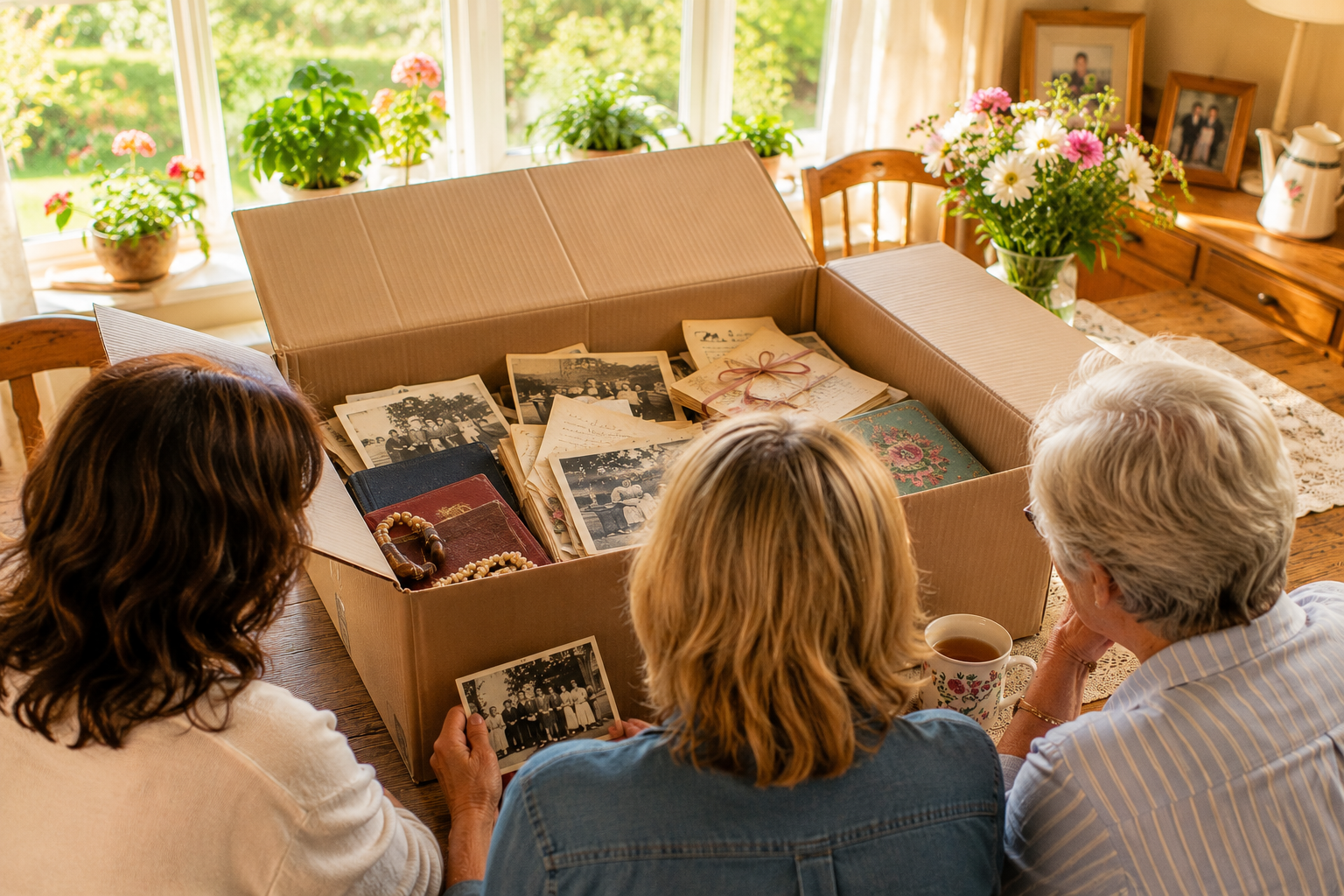
There is always that one box.
It doesn’t matter whether you’re helping parents downsize, clearing a much-loved family home or simply sorting through a lifetime of belongings after someone has moved into a smaller place. Among the neatly labelled boxes marked Kitchen, Books and Linen, there is always one that sits quietly on its own. Nobody seems to know quite where it belongs, so it moves gently from room to room as the day unfolds.
Someone places it on the dining room table before deciding they’ll deal with it later. A little while afterwards, another family member carries it into the spare bedroom because it’s in the way. Before long it has travelled through almost every room in the house without anyone lifting the lid. It’s almost as though the whole family has silently agreed that this particular box deserves to wait. It is a box nobody wants to open.
At first, everyone has perfectly sensible reasons for leaving it alone. There are cupboards that need emptying, furniture that has to be carried outside before the rain arrives and far too many books to pack before lunchtime. The practical jobs naturally take priority because they feel manageable. You know exactly what to do with a stack of dinner plates or a cupboard full of towels. They belong in boxes, they get labelled and they quietly become part of the next chapter.
That one anonymous box, however, asks something entirely different of us. It isn’t asking us to organise. It’s asking us to remember, and memories rarely work to a timetable.
I’ve watched this happen more times than I can count, and it never fails to fascinate me. Families who have spent the entire morning working efficiently suddenly become wonderfully distracted whenever their eyes fall on that box. They look at it for a moment, smile politely and then immediately find another job that feels slightly more urgent. Someone starts wrapping another plate in newspaper, another decides the garage shelves need one final look and somebody else announces that it’s probably time for another cup of tea.
Nobody says, “I don’t want to open it.” They don’t need to. Somehow everyone else already understands.
The funny thing is that this mysterious box is rarely valuable in the way people imagine. If a stranger looked inside, they might wonder why it had been treated with such careful hesitation. There are no expensive antiques tucked beneath the lid and no hidden fortunes waiting to be discovered.
Instead, it holds the ordinary things that quietly become extraordinary simply because they belonged to someone we loved. A pair of reading glasses carefully folded inside their case. A shopping list written in familiar handwriting. A recipe card stained with years of enthusiastic baking. An old wallet containing loyalty cards for shops that disappeared long ago.
None of these things would attract attention in an auction room, yet they have the remarkable ability to stop an entire family in their tracks.
I remember one afternoon when we had almost finished clearing a house. The kitchen echoed in a way it never had before because the cupboards stood empty for the first time in decades. The dining room table had disappeared beneath rolls of packing tape, marker pens and neatly labelled boxes waiting to be loaded into trailers.
We’d been laughing only moments earlier after discovering yet another tin filled with mystery screws and enough tangled charging cables to supply a small electronics shop. The mood was light, the work was going well and everyone could finally see the finish line. Then someone noticed the box beneath the sideboard.
“Should we open that one?”
The question was asked so quietly that it almost disappeared into the room, yet everything changed the moment those words were spoken. Conversations faded. Packing tape was placed gently back onto the table. Somebody switched the kettle off before it had even finished boiling. Chairs that had been stacked neatly against the wall were quietly pulled back into place, and without discussing it, everyone found themselves sitting around the table once again.
Looking back, I don’t think we gathered because of what was inside the box. We gathered because we all understood that whatever we found next deserved our full attention.
The first item resting on top was a photograph. Not a particularly remarkable photograph, if I’m honest. It had faded around the edges, one corner had been bent years before and there wasn’t even a frame to protect it. Yet the moment somebody picked it up, the room came alive. A grandson laughed because he couldn’t believe his father had once owned such enormous sideburns. Someone else pointed towards a tiny child standing in the background and realised it was an aunt they hadn’t recognised at first.
Before long, another photograph appeared, then another, until the table was covered with snapshots of birthdays, seaside holidays, family picnics and ordinary Sunday afternoons that nobody had thought about for years.
What struck me most wasn’t the photographs themselves. It was how quickly they transformed the atmosphere. Only moments earlier we’d been thinking about bubble wrap and cardboard boxes. Suddenly we were talking about camping holidays where the tent leaked every single night, Christmas lunches that somehow squeezed fifteen people around one dining room table and the old family dog who seemed to appear in every photograph ever taken.
There was laughter, gentle teasing and the occasional quiet pause as someone remembered a story the rest of the family had never heard before. The work hadn’t stopped because we were being distracted. It had stopped because we’d reached the heart of what the day was really about.
That afternoon taught me something I have never forgotten. Clearing a family home is never simply about sorting possessions. It is about carefully gathering together the little pieces of a life before they become scattered. Those ordinary objects don’t ask us to admire them. They ask us to remember the people who held them, used them, treasured them and quietly built a lifetime of memories around them.
Perhaps that is why every family has one box nobody wants to open. Deep down, we all know that once the lid is lifted, we aren’t simply looking through old belongings anymore. We’re opening the story of someone’s life.
It is always remarkable how quickly one photograph leads to another. Before anyone realises what’s happening, the table is covered with little piles of memories instead of neatly packed boxes. Someone picks up a faded holiday snapshot and immediately another family member laughs, pointing towards an old caravan that spent more time being repaired than being towed. Somebody else notices a tiny child standing barefoot in the corner of the picture and asks who it is, only to discover they’re looking at themselves forty years earlier.
The room fills with stories that nobody had planned to tell, each one quietly unlocking another until time seems to lose all meaning. The packing schedule has disappeared completely, yet somehow nobody feels they’re wasting the afternoon. If anything, it feels as though they’re finally doing the work they came to do.
Mixed among the photographs are the little things that rarely mean anything to anyone outside the family, yet somehow carry enormous weight for the people gathered around the table. A favourite wooden spoon, smooth from years of Sunday baking. Dad’s pocketknife with its worn handle. Mum’s reading glasses, folded so carefully it almost feels as though she’ll reach for them at any moment. A collection of birthday cards tied together with faded ribbon, each one containing messages that were probably read once before being tucked safely away. Looking at them, I often wonder if the people who packed that box years ago realised they were creating a time capsule rather than a storage box.
It never takes long before somebody finds something that makes the whole room laugh. Perhaps it’s an old shopping list with wonderfully impossible handwriting that nobody can quite decipher. One family I worked with discovered a handwritten note that simply read, “Don’t forget the thing.” We spent a ridiculous amount of time trying to work out what “the thing” could possibly have been. Another family found an envelope marked Very Important. Everyone leaned in with great anticipation, expecting legal documents or precious jewellery, only to discover several takeaway menus from restaurants that had closed years before and a handful of expired discount vouchers. The disappointment lasted all of three seconds before everyone burst into laughter. Even now, I still smile when I think about the solemn expression on someone’s face as they opened that envelope, convinced they were about to solve a great family mystery.
Those little moments matter far more than people realise. Laughter has an extraordinary way of making difficult days feel a little lighter. It doesn’t take away the sadness of saying goodbye to a family home, but it gently reminds everyone that the life lived within those walls was filled with joy as well as loss. Somehow, the funny discoveries become the stories people continue telling long after they have forgotten how many boxes they packed.
Among all the things that emerge from that special box, there is one discovery that seems to change the atmosphere every single time.
The recipe book.
Sometimes it’s a proper cookbook with pages stained by years of enthusiastic cooking. Sometimes it’s nothing more than a collection of handwritten recipe cards held together with an elastic band that has become so brittle it falls apart the moment it’s touched. However it appears, someone always reaches for it with particular care. There is something deeply comforting about seeing familiar handwriting describing exactly how much flour to add to a favourite cake or reminding the cook to “stir gently” as though the writer might still be standing beside them in the kitchen.
I’ve noticed that recipes have an extraordinary way of bringing people together. Nobody simply reads them. Instead, they remember them. One person recalls licking the cake mixture from the bowl while another insists the biscuits never tasted quite the same when anyone else baked them. Someone laughs about the Christmas pudding that was accidentally burnt one year, while another remembers the smell of fresh bread drifting through the house every Sunday afternoon. Before long, the recipe book has become less about ingredients and more about the ordinary family moments that quietly shaped everyone’s childhood.
One afternoon I watched three generations gathered around a single handwritten scone recipe. The youngest grandchild asked why there were no measurements in grams, only “a teacup of flour” and “a good knob of butter.” Her grandmother smiled and said, “Because that’s how she cooked. She never measured anything.” Everyone laughed because they knew it was true. Somehow those wonderfully vague instructions had produced perfect scones for decades, despite making very little sense to anyone reading them today.
It struck me that recipes are rather like family traditions. They are handed from one generation to the next, changing just a little each time but somehow remaining wonderfully familiar. Long after the baking dishes have been donated and the old kitchen has been emptied, those recipes continue bringing families together around new tables in new homes. They remind us that while houses may change, the things that truly make a family don’t fit inside cardboard boxes.
Every now and then, tucked quietly beneath the photographs and recipe books, someone discovers an old letter. Unlike the shopping lists or takeaway menus, these are rarely opened with laughter. There is usually a moment of quiet hesitation before anyone unfolds the paper. The handwriting is instantly recognisable, and for a few seconds the room becomes completely still. Nobody rushes. Nobody interrupts. It feels as though everyone instinctively understands that some words deserve to be read slowly.
Not every letter contains profound wisdom. In fact, most are wonderfully ordinary. They speak about everyday life, ask after someone’s health, describe the weather or mention plans for the following weekend. Yet those ordinary conversations become extraordinary with the passing of time. Hearing a familiar voice through familiar handwriting reminds us that love was rarely expressed through grand speeches. More often, it was hidden inside simple questions like, “Did you get home safely?” or “Don’t forget to wear your jersey if it turns cold.”
I’ve often thought that these are the real treasures hidden inside the box. Not because they are valuable in a financial sense, but because they gently remind us that the richest parts of our lives are usually the simplest. A recipe written on the back of an envelope. A faded photograph. A shopping list. A letter asking someone to come for Sunday lunch.
None of those things were ever meant to become heirlooms. Yet somehow, they become the possessions we protect most carefully of all. And just when everyone thinks they’ve reached the bottom of the box, someone notices one last envelope tucked neatly beneath everything else.
Nobody speaks. Everyone simply looks at one another because deep down, they all know that whatever comes next will be the hardest part of the day.
The final envelope is rarely dramatic. In fact, it often contains something so ordinary that, had you found it years earlier, you might not have given it a second glance. It could be a handwritten birthday card signed simply, “Love always, Mum.” It might be an anniversary card with a little joke scribbled inside, a postcard from a seaside holiday or a tiny note tucked into an old diary reminding someone to buy milk on the way home. Yet, somehow, these ordinary pieces of paper become the hardest things to put down because they are among the last places where a familiar voice still feels wonderfully alive.
I have often found myself watching families sit quietly around the table, each person holding something different but somehow sharing exactly the same emotion. Nobody is rushing to make decisions anymore. The urgency that filled the morning has quietly disappeared, replaced by something gentler. Boxes can wait another half an hour. The trailer isn’t going anywhere. For just a little while, everybody seems to understand that they are no longer sorting through belongings. They are saying thank you to a life that was lived, one small memory at a time.
Then, quite unexpectedly, someone says something that makes the whole room laugh. It happens every single time. Perhaps it’s a photograph of Dad proudly standing beside a fish that was clearly much smaller than the story suggested. Maybe it’s Mum’s recipe card where “a pinch of salt” somehow became half the packet, or an old holiday photograph where everybody remembers the rain rather differently.
Sometimes it’s simply the discovery of yet another mysterious key that nobody can identify, despite everyone confidently claiming they know exactly what it belongs to. The tears and the laughter seem perfectly comfortable sitting beside one another. I’ve grown to love that about families.
We often think we have to choose between sadness and happiness, but life rarely works that way. Some of the warmest afternoons I’ve ever spent have included both. One person quietly wipes away a tear while another is laughing so hard they can barely finish the story they’re trying to tell. Neither emotion feels out of place. If anything, they seem to make room for one another, gently reminding us that love has always contained both joy and heartache.
When the time finally comes to close the lid once again, the box almost always looks different from when it was first opened. Not because many of the contents have disappeared, but because the family has quietly changed the way they see them. Earlier in the day they were simply old photographs, recipe books, birthday cards and letters. Now every item carries a story that has been spoken aloud once more. The objects haven’t become more valuable. The memories attached to them have simply been shared, and somehow that makes them feel lighter to carry.
People sometimes ask me what they should keep when helping parents downsize or clearing a family home. I always find that such a difficult question to answer because there isn’t one correct list that suits everyone. Instead, I gently encourage people to keep the things that continue telling the family’s story. Not because they’re expensive or impressive, but because they make someone smile the moment they’re picked up. It might be a recipe book that still smells faintly of cinnamon, a faded photograph where everyone is laughing at something long forgotten or an old gardening hat that still reminds the family of Saturday mornings spent pulling weeds and arguing about the weather.
The older I become, the more convinced I am that our most precious possessions are usually the least valuable in the eyes of the world. Nobody insures a handwritten shopping list or places a financial value on a birthday card from thirty years ago. A child’s drawing folded inside a Bible won’t appear in an auction catalogue, and an old postcard from a caravan holiday certainly won’t make headlines.
Yet ask a family what they would rescue if they could only save one small box and I suspect many of those ordinary little treasures would quietly find their way inside.
Eventually, the photographs are stacked neatly together once more. The letters are carefully tied with ribbon, the recipe book is wrapped in tissue paper and the little keepsakes return to the box that has protected them for so many years. This time, however, the box feels different. It is no longer the box nobody wanted to open. It has become the one everyone is quietly glad they did.
As the afternoon draws to a close, the house begins to echo in unfamiliar ways. The pictures have been taken from the walls, the cupboards stand empty and the dining room table, which only hours earlier had been buried beneath memories, is once again ready for its next chapter. Someone carries the special box to the car with extraordinary care, not because it is heavy but because everyone now understands exactly what it contains.
Not possessions or clutter. Not even keepsakes. It carries family stories, familiar voices and laughter that still echoes through old photographs and recipes that will continue appearing on new kitchen tables for years to come.
Perhaps that is why I no longer think of it as the box nobody wants to open. I think of it as the box that quietly reminds us what home really means.
Home was never the walls, the roof or the furniture. Home was always the people who filled those rooms with ordinary moments that slowly became extraordinary memories and those memories don’t stay behind when the front door closes for the last time.
They come with us.
Because it usually contains sentimental items rather than practical belongings. Photographs, letters, recipe books and personal keepsakes often bring back powerful memories that deserve time and care.
Not necessarily. Choose the items that genuinely tell your family’s story or bring you comfort. It’s perfectly all right to photograph larger collections and keep only the pieces that mean the most.
Allow them the time they need. Listen to the stories they want to share, avoid rushing difficult decisions and remember that emotions are a natural part of saying goodbye to a family home.
Consider storing them in archival folders or keepsake boxes to protect them. You might also scan them so future generations can enjoy them without risking damage to the originals.
Because families naturally balance sadness with laughter. Sharing funny memories, discovering unexpected keepsakes and remembering everyday moments often helps everyone feel connected and reminds us that a life well lived is filled with joy as well as tears.
If today’s article touched your heart, you may also enjoy these other stories from the Rustic Daisy Home Transitions collection. Together they celebrate the memories, laughter and love that make every family home unique.
Sometimes it’s the unexpected discoveries that become our favourite memories. From biscuit tins full of buttons to mysterious keys, every family seems to uncover the same wonderful surprises.
Every family approaches decluttering differently. Discover the familiar personalities that quietly emerge whenever loved ones gather to clear a family home.
You will almost certainly recognise the phrases every family repeats while packing boxes, sorting keepsakes and promising they’ll “deal with that later.”
Making decisions about sentimental belongings can feel overwhelming. This gentle guide may help you decide what truly deserves a place in the next chapter.
Before the special box is packed away again, take a little time to organise the paperwork your family may one day need.
Thank you for spending a little time with me today.
If you’ve ever stood in front of that one unopened box, wondering whether today was the day to lift the lid, I hope this story reminded you that there is no right or wrong way to approach those moments. Some memories make us laugh, some bring tears and many do a little of both. That’s simply what happens when a lifetime has been lived well.
Here at Rustic Daisy, I believe our homes are much more than the places where we live. They’re the backdrop to ordinary days that quietly become extraordinary memories. Whether you’re helping ageing parents, beginning a new chapter or simply creating a calmer home, I hope you’ll always find practical ideas, gentle encouragement and a warm welcome here.
Until next time, thank you for letting me share a cup of tea and a story with you.
With love,
Sharon
– Finding comfort, courage and beauty in life’s everyday transitions.