

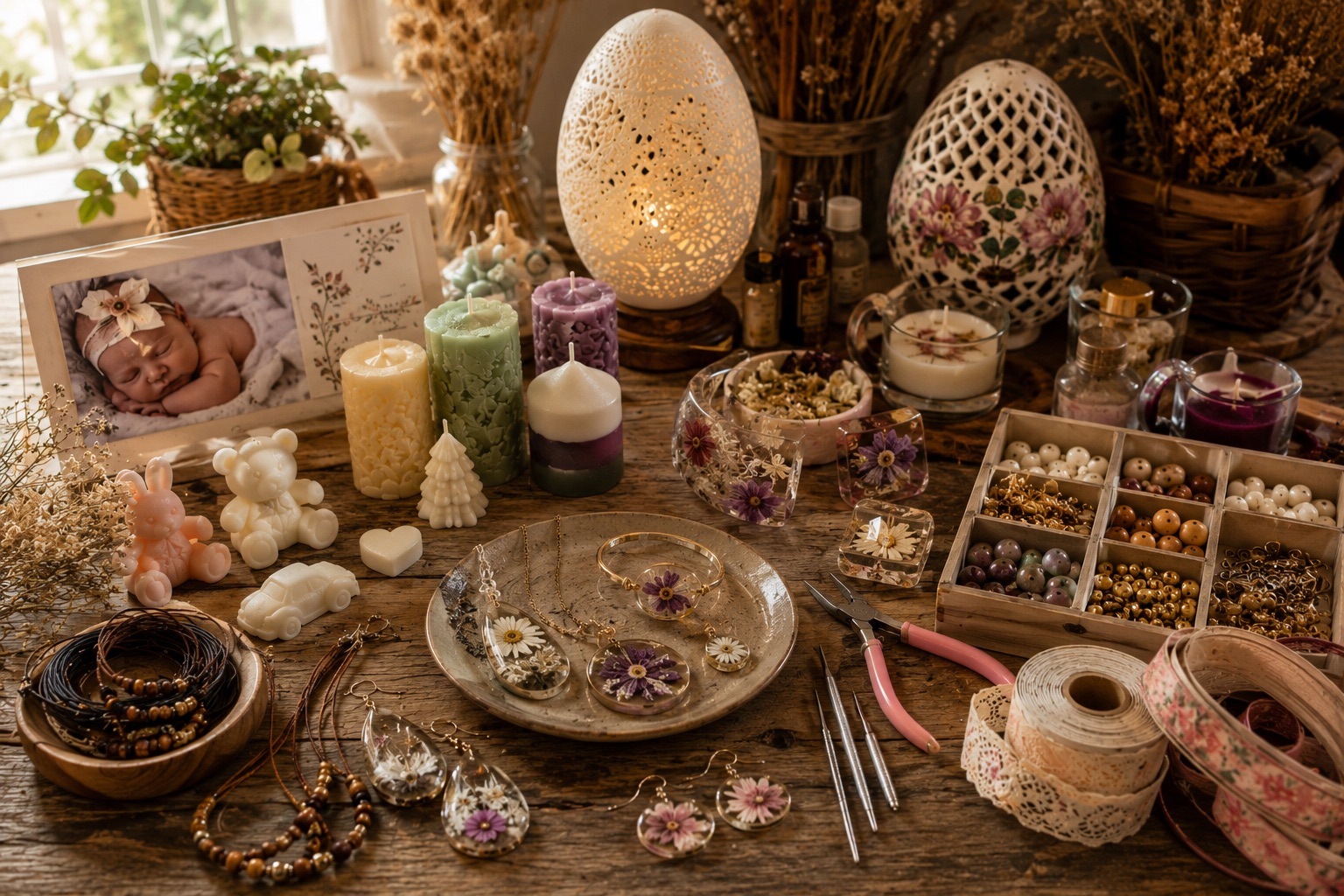
There is something rather satisfying about making something with your own hands. You start with a pile of materials that don’t look particularly exciting, spend a few hours experimenting, and somehow end up holding something that wasn’t there before. Perhaps it is beautiful, perhaps it is useful, perhaps it is something that makes somebody else smile. Sometimes, if you’re very lucky, somebody actually wants to give you money for it.
I’ve discovered that last part several times throughout my life and on several occassions I have turned crafts into small businesses.
My journey from making things to making money hasn’t followed a carefully planned business strategy. There was no master plan sitting in a drawer waiting for the right moment. Instead, there have been ideas, experiments, happy accidents, some very enthusiastic customers, a few things that didn’t quite work and a fair amount of learning along the way.
I’ve made cards featuring newborn babies, carved and decorated ostrich eggs, made lariat necklaces, run a shop selling candles and other beautiful things, and, more recently, started making jewellery using dried flowers preserved in resin.
The businesses have been very different, but there has been one constant.
I absolutely love making things.
For me, creating something beautiful has never felt quite like work. It has been a source of enjoyment, creativity and, at various points in my life, something therapeutic to focus on when I needed it. Eventually I discovered that something I enjoyed doing could also provide an income.
That doesn’t mean it was easy money.
Far from it.
My first little craft business was around 1997, when I was a stay-at-home mum.
I started taking photographs of newborn babies in the maternity wards at a local private hospital and turning those photographs into special cards for the new parents. The cards had spaces where the parents could record all those precious details that are so easy to forget later: the baby’s name, weight, length, time of birth and other little pieces of information.
It was a simple idea, but I loved it.
One of my most memorable moments was presenting the first card to the parents of a newborn baby. They were absolutely thrilled and became tearful when they saw their baby’s photograph. There is something rather lovely about creating something that captures a moment that a family will never get back.
I didn’t make a fortune from the cards, but that wasn’t really the point. I was at home with my children, I enjoyed doing it and it gave me a little bit of pocket money.
Eventually my husband was transferred and we moved to another country, so that little business came to an end.
At the time, I didn’t think I was beginning a lifelong relationship with craft businesses. I was simply making something I enjoyed.
I would discover later that this was going to become a recurring theme in my life.
Around 2002 I started Big Bird Creations, which was considerably more adventurous than baby cards.
I began decorating ostrich eggs. Not just by painting a pretty picture on one and calling it a day.
I experimented with engraving patterns and cutting designs into the shells using a dentist’s drill. I also decoupaged and painted designs onto the eggs and turned some of them into candle holders and lamps.
This was the first time I really thought, Perhaps I could actually make money from this.
I’d decorated a couple of eggs and people who saw them kept asking whether I could make some for them. That was my first real indication that something I had made purely because I enjoyed it might have commercial potential.
So I experimented with different techniques and started approaching places that might be interested in selling them. I sold them through décor and craft shops and also to resorts and game reserves. One particularly interesting aspect was creating eggs with the establishment’s logo transferred onto them.
That was a proper little business. It also taught me that customers can have very different ideas about what makes a product appealing.
Some people loved the eggs. Others were put off by the fact that they were an animal product. I also discovered that trying to sell them internationally brought another set of complications because there are strict rules around sending animal products between countries.
There were also concerns from some potential customers about the fact that the eggs were organic objects and whether they might harbour bacteria. I knew how meticulously I had cleaned them during my preparation process, but customers are entitled to have their own concerns about what they are buying.
Eventually I also started developing an allergy to the dust created while engraving the eggs, which made continuing the business impractical.
Big Bird Creations taught me something that has stayed with me ever since:
A beautiful product isn’t automatically an easy product to sell.
There are practical considerations, customer perceptions, regulations, health considerations and all sorts of things you don’t necessarily think about when you’re sitting at home happily making something.
Around 2008, I started another little venture called Strings and Things.
This time I was making lariat necklaces from waxed cord, with groups of beads placed at intervals along the cord. The design gave the wearer different options for how long the necklace could be worn.
It was quite different from the ostrich eggs.
I wasn’t trying to build a large business. I sold the necklaces once a week at the local farmers’ market as a side-line business and made some really nice pocket money from it. There was something rather satisfying about that arrangement.
I could make the necklaces during the week and sell them at the market. I didn’t have the commitment of a shop, with all the monthly expenses that come with having a premises, but I still had the enjoyment of meeting people and seeing which designs caught their attention.
Eventually I was offered a very good job managing a hotel. The problem was that the job required me to work weekends, which meant I could no longer attend the farmers’ market. So Strings and Things came to an end.
Again, the business didn’t stop because the products weren’t selling. Life simply changed and that is something I’ve experienced repeatedly. Sometimes a small business ends because the business fails. Other times it ends because circumstances change and take you in another direction.
My next business was a much bigger step.
From 2017 to 2019, I ran Rustic Daisy, a physical shop selling decorative and personalised candles, quality faux designer perfumes, essential oils and natural soaps. I also offered candle dipping for children which was really fun.
This was the business that changed my understanding of what it meant to actually run a small business because it became my only income and it was, without question, my most financially successful craft business.
I loved the combination of making and selling. I could be in the shop creating products while also interacting with customers. People would come in with ideas for special occasions and I could make personalised candles for weddings, Mother’s Day, memorials and other meaningful events.
That part of the business was particularly rewarding because I wasn’t simply making something and hoping somebody would buy it. I was making something specifically for a person and their occasion.
Then there was the candle dipping.
Watching children dip their candles into different colours of wax was one of my favourite parts of the business. They would watch with complete surprise and wonder as the candle emerged in a different colour each time.
Children have a wonderful ability to find magic in something as simple as dipping a candle into wax.
I had to make sure I had plenty of plain white candle “blanks” ready for them. Hearts, cars, bunnies, trees, teddy bears and all sorts of other shapes would sit waiting for little hands to turn them into something colourful and completely their own.
When I eventually closed the shop, I had boxes full of these candle blanks left over. In fact, I still have quite a few in storage.
Perhaps one day I’ll start candle dipping again purely for fun. Never say never.
One of the things that made the Rustic Daisy shop so special was how people found me. New customers would come through the door saying they had heard about the shop from a friend or family member.
Then another person would arrive. And another. It was wonderful to realise that people were talking about the business and recommending it to other people.
That was probably the moment when I thought, Yes, I can actually do this.
There is a very particular feeling when you realise that people aren’t simply buying something because you’ve asked them to. They are coming back, recommending you and bringing other people with them.
It made the business feel real. Running a successful shop also taught me one of my biggest business lessons.
You have to make provision for the quiet times.
School holidays and peak seasons could bring in lovely money, but the rent and other ongoing expenses didn’t disappear when business became quieter.
A shop can be busy one week and considerably quieter the next. You still have bills to pay regardless.
I learned that you cannot simply look at the money coming in during your busiest periods and assume that is what the business will look like throughout the year.
You need to plan for the quieter spells and sometimes you need to plan for things you never saw coming.
In my case, that unforeseen circumstance was cancer treatment. When I was diagnosed with cancer, it became impossible for me to continue running the shop whilst undergoing treatment, and I had to close Rustic Daisy.
It wasn’t because the business wasn’t working or because customers had stopped buying. It was simply because life had changed and I needed to deal with what was in front of me.
That experience taught me another lesson that I don’t think can be learned from a business book.
A small business is part of your life and life doesn’t always ask permission before changing the plan.
Years later, in 2025, I found myself making things to sell again.
This time the business became Rustic Daisy Adornments, making pendants, bracelets and earrings incorporating dried flowers delicately preserved in resin.
I was working for a company that only needed me for three days a week. That arrangement had been manageable when I had a partner and our expenses were shared, but my relationship with my boyfriend of eight years ended and I needed to earn more money.
I was also dealing with the loss of my mum, so emotionally I was not exactly in the best place.
I had a choice.
I could continue working for somebody else, doing something I didn’t particularly enjoy, or I could bite the bullet and start doing what I knew I loved.
Creating beautiful things.
So I chose creativity.
Crafting has always been healing for me. It gives my mind something to focus on and allows me to take something from an idea in my head and turn it into something I can actually hold in my hands.
This time, however, I was starting a craft business in a very different world.
When I was selling the ostrich eggs, if I wanted a shop to see my products I had to physically take samples to them. I remember dragging a suitcase full of ostrich egg samples around the country to show prospective clients what I was making.
Other people’s shops were the main outlet available to me. There was no online shop waiting for me to upload a photograph and click publish.
Today, things are very different. With Rustic Daisy Adornments, I have my own online shop on my website as well as selling through a number of physical shops. A customer can see a piece online, order it and have it posted to them.
That saves an incredible amount of time and energy that can instead be spent doing what I actually enjoy most:
making more things.
It is difficult to overstate how different that feels compared with physically carrying your products around looking for somewhere to sell them. The technology has changed enormously, but the fundamental part hasn’t changed at all.
Someone still has to like what you’ve made enough to want to buy it.
One of the hardest lessons for me has been learning how to price things properly. When you love making something, it can feel strange asking someone to pay you for it.
I think part of the problem is that when you’re sitting at home creating something you enjoy, it doesn’t feel like work so why would somebody pay you a proper price for it?
That was something I had to work through with every business. I had help from friends and family and researched similar products to get a better understanding of what things should cost. I gradually learned that enjoying your work doesn’t mean your time has no value.
If you are buying materials, spending hours making something, packaging it, transporting it and selling it, there is considerably more involved than simply the cost of the raw materials.
Pricing is one of those things that looks simple until you actually have to put a price tag on something you’ve lovingly made yourself.
This is where I think people can get a little carried away when they hear about making money from hobbies. It sounds wonderful.
I love making candles. I’ll sell candles.
I love jewellery. I’ll sell jewellery.
I love sewing. I’ll sell what I make.
And yes, you absolutely can but it is not easy money. One of the biggest misconceptions I have encountered is that making money from crafts is somehow an effortless way to earn an income. It really isn’t.
You need to make and sell considerably more products than you might initially imagine if you want the business to provide a proper living. There are materials to buy, products that take longer to make than expected, things that don’t sell, packaging, selling costs and quiet periods to consider.
You also have to actually sell the things. Making something beautiful is one skill. Convincing somebody that they want to own it is another.
I have learned both lessons.
If you asked me which of my businesses I am most proud of, I honestly couldn’t choose just one. I am proud of all of them.
The baby cards were small but they created something meaningful for new parents.
Big Bird Creations pushed me to experiment with techniques I had never tried before and showed me that something I had created could become a proper product.
Strings and Things gave me a lovely little side income whilst allowing me to enjoy a weekly farmers’ market.
Rustic Daisy became a successful shop and my only income for a time.
And Rustic Daisy Adornments has brought me back to creating and selling beautiful things again.
I’ve also created plenty of crafts along the way that haven’t necessarily become businesses. Some were simply things I wanted to learn. Some were gifts. Some were things I made because I needed something to occupy my hands and my mind during a difficult period of life.
I think that is perhaps why I have kept coming back to crafting. For me, it has never been only about the money.
Absolutely. In fact, I already have. Several times.
Would I do everything exactly the same way? Probably not. I’ve learned too much along the way to make that possible.
I’d think more carefully about pricing. I’d pay much more attention to ongoing expenses. I’d think about how and where a product can realistically be sold before making huge quantities of it. I’d also remember that a quiet month doesn’t necessarily mean the business is failing, but it does mean you need to have planned for it.
Most of all, I would remember that the business needs to fit into my life rather than expecting my life to fit perfectly around the business.
If you’ve ever looked at something you’ve made and thought, “I wonder if I could sell these?”, my answer is simple.
Go for it.
You don’t have to start with a shop. You don’t have to buy enormous quantities of supplies. You don’t have to turn your hobby into a full-time business.
You could start with friends and family. Encourage them to tell their friends and extended family. Try a small online shop. Test a few products. See what people actually respond to.
The beauty of starting small is that you can learn without immediately putting everything on the line and don’t measure success only by whether you eventually build a huge business.
If your little craft business pays for the supplies for your hobby, that’s something.
If it gives you a bit of pocket money, that’s something.
If it eventually becomes a meaningful income, that’s something too.
And if you discover that you simply love making things and don’t actually want to sell them, that is perfectly fine as well. You don’t have to monetise every enjoyable thing in your life.
For me, though, there is something incredibly rewarding about waking up in the morning knowing that I am going to make something beautiful that day.
I still love that feeling. Perhaps that’s why, after all these years, I’m still doing it.
Yes. My own experience has shown me that it is possible to turn different crafts into anything from a little pocket money to a genuine source of income. However, it isn’t easy money. You need to make enough products to sell, price them properly and account for all the costs involved in running the business.
It can be, particularly if you start small and test whether people actually want to buy what you make. My businesses have ranged from very small side-line ventures to a shop that became my only income. Starting small allows you to learn without immediately taking on major expenses.
You don’t always know. One of the biggest lessons I’ve learned is that the products I thought would sell aren’t necessarily the ones customers choose. Watching what people respond to, listening to customers and being willing to adjust your products can teach you far more than guessing.
Start by understanding the cost of your materials and other expenses, then consider the time involved and what comparable products are selling for. I personally found pricing difficult because I enjoyed making things so much that it didn’t feel like work. Research and advice from others helped me develop more realistic pricing.
It can, but it depends enormously on the products, demand, pricing, costs and selling opportunities. My Rustic Daisy shop became my only income and was my most financially successful craft business, but that also meant I had to think carefully about quiet periods and ongoing expenses.
Online selling can remove some of the physical work involved in getting products in front of customers. When I was selling ostrich eggs, I physically travelled with samples to prospective businesses. Today, I can sell through my own website and post products to customers. The two approaches have very different advantages and challenges.
Absolutely not. A hobby can simply be something you enjoy. For me, however, turning creativity into income has been extremely rewarding, and even a small amount of income that helps pay for the hobby can make the experiment worthwhile.
One of the lovely things about discovering a craft is discovering all the tools, materials and little pieces of equipment that make creating even more enjoyable. If you’re thinking about trying a craft yourself, I’ve included some products below that may be useful.
Some of the links in this section may be affiliate links, which means I may receive a small commission if you purchase through them, at no additional cost to you. I only want to recommend things that are genuinely relevant to the craft or creative journey I’m talking about.
Rolling craft storage trolley – This storage cart is perfect for keeping your space tidy and organised. Great for crafting
Clear storage bins with lids – Being able to see what’s inside makes it much easier to stay organised.
Pegboard wall organiser – This peg board is great for organising all your essentials!
Craft storage drawersI – love this drawer organiser! All your craft supplies neatly organised.
Label Maker – Perfect for labelling storage boxes
Mason jars with lids – I love these for craft supplies
Scrapbook paper organiser – Got a lot of paper to sort? This organiser is a game changer!
Adjustable shelving units – Need extra storage? This sturdy shelving unit is perfect for any room.
Craft tool organiser – This 3-layer storage box is perfect for organising your craft tools.
Affiliate Disclosure: Some of the links in this article may be affiliate links. If you purchase something through one of these links, I may receive a small commission at no extra cost to you. Thank you so much for supporting Rustic Daisy in this way. Every little bit helps me continue creating, writing and sharing these stories with you.
If you enjoy making things too, you might like some of my other Rustic Daisy stories about creativity, crafting and finding practical ways to make the things you love part of everyday life. These aren’t business stories, but they are part of the same bigger idea — that creativity can bring purpose, enjoyment and healing into our lives.
Until next time, keep creating, keep experimenting and never underestimate what those creative hands of yours might be capable of.
Love,
Sharon