

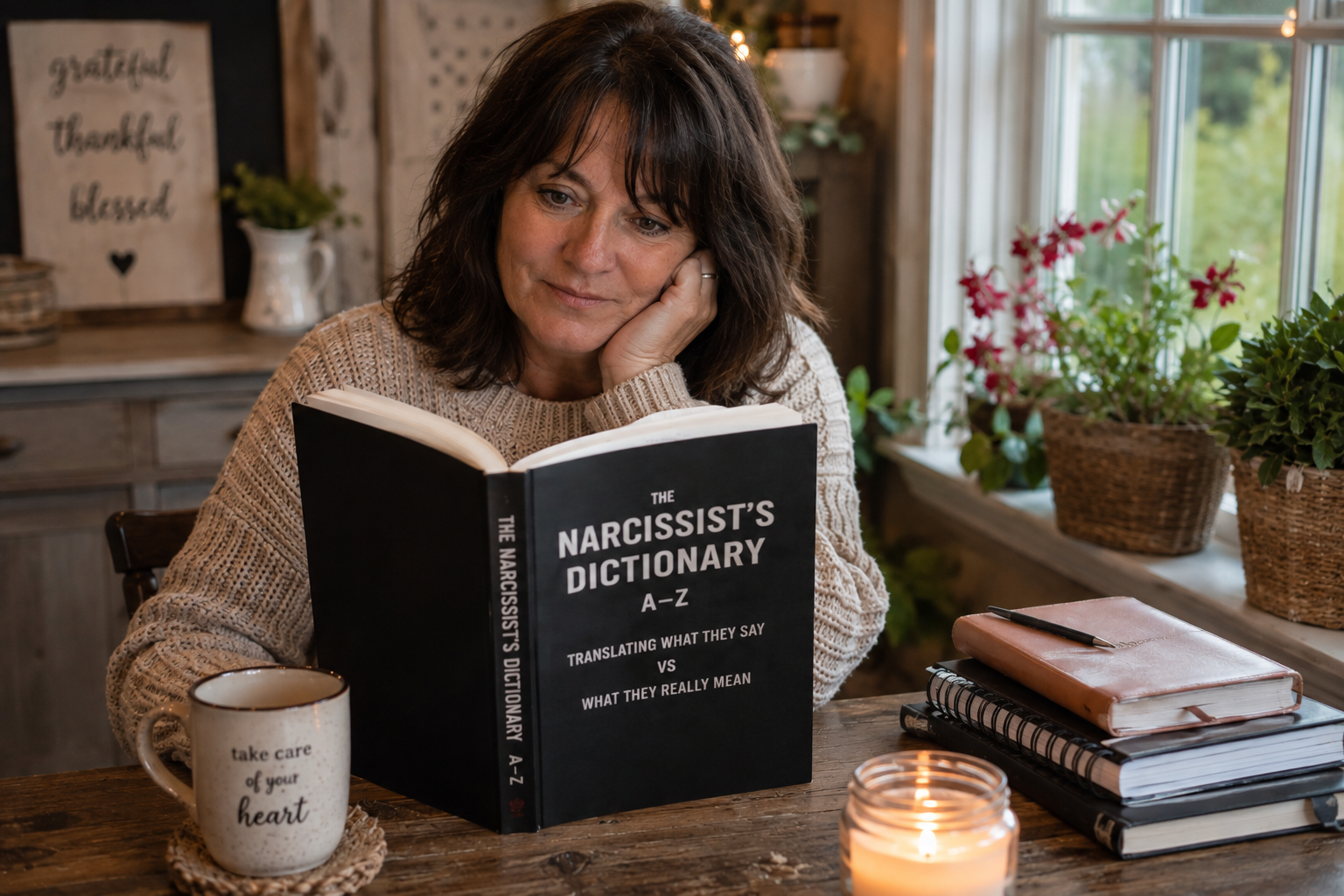
By now, our imaginary Narcissist’s Dictionary has become quite a substantial little publication. In Part 1, we looked at some of the classics, including “You’re too sensitive”, “I was only joking”, “You’re imagining things” and the rather impressive conversational detour of “You’re the narcissist.” We discovered that a simple disagreement can sometimes begin with one subject and somehow end with an unexpected examination of your entire personality.
In Part 2, things became even more interesting. We translated the carefully worded “I’m sorry you feel that way”, the ever-popular “You made me do it” and the emotionally expensive “After everything I’ve done for you…” We also discovered that the words “everyone”, “always” and “nobody” can apparently be called upon to provide supporting evidence whenever a conversation needs a little extra drama. None of these phrases automatically mean that the person saying them is a narcissist, of course. People are complicated creatures and sometimes we all say things badly. The fun comes from recognising the patterns and, perhaps, learning not to get quite so tangled up in them.
So, with our imaginary dictionary firmly open and a cup of tea within reach, let’s carry on with Part 3 of The Narcissist’s Dictionary
What they say: “That’s not what I meant.”
What they may mean: “I would like to change the meaning of what I said now that I know you didn’t like it.”
This can be a perfectly legitimate sentence. We all misunderstand each other from time to time. Tone is notoriously difficult to interpret, particularly over text messages, where a simple full stop can apparently have the emotional weight of a declaration of war.
Someone says something.
You interpret it one way.
They explain that they meant something completely different.
Fair enough.
That happens.
The interesting part comes when the explanation changes every time you mention the original words. First they didn’t say it. Then they said it but didn’t mean it. Then they meant something else. Then you took it out of context. Then you misunderstood the context. Eventually the conversation has become so complicated that you are considering applying for a degree in conversational archaeology.
At some point, it is perfectly reasonable to say, “Perhaps we understood that differently,” and leave it there. You don’t need to spend the rest of the evening reconstructing the exact emotional meaning of a sentence that was apparently written in a language only the other person understands.
Sometimes communication really is unclear.
Sometimes, however, the explanation seems to change because the original statement has become inconvenient.
And that is when our dictionary quietly adds a little footnote.
What they say: “I don’t owe you an explanation.”
What they may mean: “I would prefer you not ask questions.”
There are certainly circumstances in which nobody owes us an explanation. Adults are entitled to privacy, independence and personal decisions. We don’t get to interrogate every person we know simply because we are curious.
But there is a rather important difference between privacy and accountability.
If someone wants to keep their holiday plans private, that’s their business.
If someone has borrowed your car, returned it with an interesting new dent and then announces that they don’t have to explain themselves, you may reasonably feel that a small explanation would be useful.
Relationships work because people communicate with one another. When someone refuses every reasonable question by turning it into an accusation of control, the original question can disappear underneath the argument about whether you were entitled to ask it.
And this is where it helps to remember that asking a question isn’t necessarily an attempt to control someone.
Sometimes a question is simply a question.
“What happened?”
“Where were you?”
“What did you mean?”
“Why did you say that?”
These aren’t automatically interrogations.
Although, if someone answers “Why are you so obsessed with me?” after you ask where the television remote has gone, perhaps our dictionary needs a completely separate section for household mysteries.
What they say: “You’re being controlling.”
What they may mean: “I don’t want to consider your request.”
This phrase can be particularly confusing because there is a real difference between controlling behaviour and ordinary relationship expectations.
Telling someone who they may see, what they may wear, where they may go and who they may speak to is controlling.
Saying, “Please don’t speak to me like that,” is a boundary.
Saying, “I’d like us to discuss this before we make a decision that affects both of us,” is communication.
Saying, “Could you please let me know if you’re going to be late?” is generally just good manners.
Yet sometimes any request, boundary or expression of discomfort can be labelled controlling when somebody simply doesn’t want to accommodate it.
This is where things can become rather muddled. If one person treats every reasonable request as an attempt to control them, the other person can eventually become frightened to ask for anything at all.
You start editing your sentences before you say them.
You rehearse.
You soften.
You add “if you don’t mind”.
You add “only if you’re okay with it”.
You perhaps add a small weather report for good measure.
Eventually you’re saying, “I was just wondering, and absolutely no pressure whatsoever, and please don’t misunderstand me, but would it possibly be okay if…”
And they still accuse you of being controlling.
At that point, the problem may not be your wording.
What they say: “Prove that you love me.”
What they may mean: “I would like your love to require you to do what I want.”
This phrase deserves a particularly large entry because love is one of the easiest things in the world to turn into emotional currency.
If you loved me, you would agree.
If you loved me, you would come.
If you loved me, you would choose me.
If you loved me, you wouldn’t need that boundary.
It sounds romantic until you think about what is actually being requested.
Love is not supposed to be a loyalty card where enough points eventually earn you the right to disregard your own needs.
Healthy love allows two people to remain separate human beings. You can love someone enormously and still say no. You can care deeply about someone and still have different opinions. You can adore your family and still not attend every single family event because, quite frankly, you have reached your annual limit for small talk.
Love does not require the disappearance of your own judgement.
In fact, the strongest relationships usually have enough security for both people to say, “I love you, but I don’t agree.”
That sentence should not require an emergency evacuation.
What they say: “I’m independent.”
What they may mean: “I don’t particularly enjoy being accountable to anyone.”
Independence is wonderful. I am a great supporter of adults making their own decisions without needing a committee to approve their breakfast choices.
But independence and accountability are not enemies.
You can make your own decisions and still understand that your decisions affect other people.
If you live alone and decide to paint your kitchen purple, congratulations. Nobody needs to be consulted unless you happen to be renting the house.
If you share a home with somebody and announce that the kitchen is becoming purple at eight o’clock tomorrow morning, there may be a slightly longer discussion.
Being independent doesn’t mean being exempt from consideration.
It also doesn’t mean that every suggestion is an attempt to control you. Sometimes another person is simply pointing out that your decision has consequences.
We are all free to make choices.
We are not always free to choose the consequences.
That distinction can save an extraordinary amount of unnecessary arguing.
What they say: “Your behaviour is embarrassing me.”
What they may mean: “I am more concerned about how this looks than what is actually happening.”
This one is particularly interesting because appearances can become incredibly important when somebody cares deeply about how they are perceived.
Everything can be perfectly fine behind closed doors, provided nobody outside the house knows what is happening.
The family photograph must look lovely.
The social media post must look happy.
The dinner party must be flawless.
Nobody must know that five minutes earlier somebody was having a spectacular argument over whose turn it was to buy bread.
There is nothing wrong with caring about your reputation. Most of us would prefer not to be known around town as the person who regularly reverses into letterboxes.
But there is a difference between wanting to behave well and wanting to appear well-behaved.
When appearances become more important than reality, problems can get swept under the rug simply because acknowledging them might make somebody look bad.
And that is where the phrase can become particularly revealing.
“Don’t make me look bad” is very different from “Let’s make sure we’re treating each other properly.”
The first is about appearances.
The second is about behaviour.
They are not quite the same thing.
What they say: “Nobody understands me.”
What they may mean: “I would like you to take my side without questioning my version of events.”
There are times when life really does feel as though everyone has mysteriously joined the opposition. We all have those days. You have a difficult morning, your coffee goes cold, somebody sends an irritating email and then you discover that the supermarket queue you chose is moving at the speed of continental drift.
For a brief period, it may genuinely feel as though the universe has singled you out.
The difference is what happens when every disagreement becomes evidence of persecution.
If a friend disagrees, they’re against you.
If a colleague offers criticism, they’re jealous.
If a family member sets a boundary, they don’t care about you.
If somebody doesn’t immediately agree with your version of events, they must have been influenced by someone else.
Eventually the entire population becomes part of the conspiracy.
At some point, it may be worth considering the slightly less exciting possibility that other people are simply allowed to have different opinions.
This is one of the harder lessons in relationships because disagreement can feel uncomfortable. But somebody disagreeing with us doesn’t automatically mean they don’t love us.
Sometimes it means they are simply sitting on the other side of the argument.
Which, surprisingly, is allowed.
What they say: “This isn’t important.”
What they may mean: “I don’t think this is important, so I don’t want to discuss why it matters to you.”
This is another phrase that can leave a person feeling rather silly for having raised an issue in the first place.
Perhaps something genuinely bothered you, but it seems small when you say it out loud.
Maybe it was the comment someone made.
Maybe it was being left out.
Maybe it was something that happened repeatedly rather than once.
And perhaps, when you tried to talk about it, you were told that you were making a big deal out of nothing.
The trouble with this phrase is that “nothing” is wonderfully subjective.
What is insignificant to one person may matter enormously to another.
I don’t care about football. Somebody else could probably explain the league table to me three times and I would still be staring blankly at the television wondering when the gardening programme is coming back.
That doesn’t mean football is objectively meaningless.
It simply means it isn’t meaningful to me.
The same applies to feelings.
You don’t have to agree that something matters in order to understand that it matters to someone else.
That little distinction can make a tremendous difference in healthy relationships.
What they say: “I’m calmly stating my position.”
What they may mean: “I would like to continue arguing while insisting that I am not arguing.”
This may be one of my personal favourites because it can be delivered while somebody is standing in the kitchen gesturing enthusiastically with a wooden spoon.
“I am not arguing.”
Of course not.
You are merely speaking at a volume that has alerted the neighbours.
There is nothing wrong with disagreement. In fact, healthy relationships need room for it. Two people are never going to agree about everything, unless one of them has stopped having opinions.
The problem comes when one person insists that they are simply communicating while the other person is supposedly being emotional, difficult or argumentative for responding.
Sometimes the most sensible thing you can do is stop trying to prove whether or not an argument is technically taking place.
Call it a discussion.
Call it a disagreement.
Call it an energetic exchange of differing perspectives.
Call it Tuesday.
The label matters considerably less than whether the two people are actually listening to each other.
What they say: “You don’t see things the way I do.”
What they may mean: “Your perspective is inconvenient.”
This is another phrase that can be completely innocent. Sometimes we genuinely don’t understand another person’s feelings or motivations. We haven’t lived their life, experienced their circumstances or seen the world through their eyes.
But there is a difference between saying, “I don’t think you understand how this feels for me,” and using “You don’t understand” as a way of dismissing every opinion that doesn’t match your own.
The first invites conversation.
The second ends it.
And perhaps that is the real lesson hidden inside our rather ridiculous little dictionary.
The words themselves are not always the issue.
Context matters.
Patterns matter.
Most importantly, what happens when you gently disagree matters.
A person who can hear your concern, think about it and perhaps say, “I hadn’t looked at it that way,” is showing you something very different from someone who immediately turns the conversation back on you every single time.
After all these entries, there is one thing worth saying before we close the dictionary and put it back on the imaginary bookshelf.
Not every difficult person is a narcissist.
Not every defensive comment is manipulation.
Not every disagreement is a psychological battle.
Sometimes people are tired. Sometimes they are embarrassed. Sometimes they are having a bad day. Sometimes they genuinely misunderstand what happened. And sometimes, if we’re being completely honest, we are the difficult person in the conversation.
That last one isn’t particularly comfortable, but it is healthy.
The difference is that most of us can eventually stop, think about what happened and admit when we got something wrong. We can apologise without demanding a medal for doing it. We can hear that we hurt someone without immediately explaining why they shouldn’t have been hurt. We can disagree without needing to destroy the other person’s version of reality.
That ability to reflect is worth far more than having the last word.
And perhaps that is why learning to recognise narcissistic communication patterns can be useful without becoming obsessed with labels. You don’t necessarily need to decide exactly what somebody “is”. You simply need to notice how you feel during repeated interactions and whether there is room for honesty, accountability, respect and disagreement.
If every conversation leaves you confused, guilty, defensive or responsible for someone else’s behaviour, that is information worth paying attention to.
You don’t have to become a psychologist.
You don’t have to become an expert in personality disorders.
And you certainly don’t need to carry The Narcissist’s Dictionary around in your handbag, although I still think there is a potential publishing opportunity here.
Sometimes you simply need to recognise the conversation for what it is and decide whether you want to keep participating in it.
Because not every sentence requires a response.
Not every accusation requires a defence.
Not every argument needs a winner.
And sometimes the most powerful translation of all is simply this:
“I heard what you said. I don’t agree. And I’m not going to spend the rest of the afternoon explaining myself.”
Now that is a sentence worth putting on a fridge magnet.
It can be, particularly when love is being used to pressure someone into doing something they are uncomfortable with. Healthy relationships allow people to love each other while still having different opinions, needs and boundaries.
No. A boundary explains what you are comfortable with and what you will do if that boundary is crossed. Controlling behaviour attempts to dictate another person’s choices, behaviour or relationships. The distinction is important, particularly in complicated relationships.
Changing the subject can sometimes be a way of avoiding the original issue, particularly when someone feels defensive or does not want to accept responsibility. However, people can also change subjects simply because they are overwhelmed or because several issues genuinely need discussing. Looking at repeated patterns is more useful than focusing on one conversation.
No. In most personal relationships, you don’t actually need a diagnosis or label to recognise that a particular pattern of behaviour is unhealthy for you. What matters more is whether you feel respected, whether you can communicate safely and whether the relationship allows reasonable boundaries and disagreement.
Sometimes the most useful response is to stop trying to win the argument. You can calmly state your position, acknowledge that the other person sees things differently and decide that continuing the discussion is no longer productive. You don’t have to answer every accusation or defend every detail of your character.
If this article has reminded you of someone in your own life, you may find it helpful to have a few gentle resources nearby. These are not magic solutions and they certainly cannot change another person’s behaviour, but sometimes the right book, journal or small comfort can help you feel a little less alone while you work out what you need.
The Gaslight Effect Recovery Guide- Dr Robin Stern – This book is a must-read if you are suffering from emotional abuse. It’s a journey towards healing and understanding.
Set Boundaries, Find Peace: A Guide to Reclaiming Yourself by Nedra Glover Tawwab – A must read for anyone struggling with boundaries. This book really helped me.
The Body Keeps the Score: Brain, Mind, and Body in the Healing of Trauma – A must-read for understanding trauma and healing!
When Things Fall Apart: Heart Advice for Difficult TimesThis book is the perfect read when you need some comfort and guidance.
Memory journal – This journal helps to remember and heal. Perfect for those who lost someone dear.
Daily gratitude journal – I love starting my day with a little gratitude practice. This journal makes it super easy!
Weighted blanket – This weighted blanket will help you sleep better. It’s super soft and cooling too!
Herbal tea gift box – This tea gift set is perfect for relaxing. It includes a beautiful ceramic cup.
Self-care gift basket – This care package is perfect for anyone who needs a little comfort and positivity!
Adult colouring book – These adult coloring books will help you relax and find inner peace.
Colouring pens – These markers are perfect for coloring, sketching, and journaling! They have a dual tip so you can switch between a fine tip and a brush pen.
Some of the products mentioned in this article may contain affiliate links. If you choose to purchase through one of these links, Rustic Daisy may receive a small commission at no additional cost to you. I only recommend products that I believe may be genuinely useful to my readers. Thank you for supporting The Rustic Daisy
Emotional manipulation rarely exists on its own. Many people who experience gaslighting also struggle with difficult family relationships, narcissistic behaviour and unhealthy boundaries. If you’re beginning to recognise these patterns, you may also find these articles helpful as you continue your healing journey.
Part 1 of The Narcissist’s Dictionary
Part 2 of The Narcissist’s Dictionary
What are healthy family boundaries
Does a narcissist know that they are a narcissist?
The most powerful healing happens in silence
Behaviours narcissists can’t hide forever
Creating a cozy home after a major life transition
Some seasons of life teach us to speak up. Others teach us that we don’t have to explain ourselves quite so much. Either way, I hope you find a little more peace, a little more confidence and perhaps a good cup of tea along the way.
With warmth,