

There is a moment that seems to happen in almost every family, no matter where you live or how organised you think you are. It usually begins with the best of intentions. Someone puts the kettle on, another person opens the curtains to let the morning light in, and somebody cheerfully announces, “Right, let’s get this done.”
If only it were that simple. I’ve helped many families with clearing a home, enough homes to know that very little actual clearing happens in the first hour. Before a single cupboard has been cleared, someone has found an old photograph, another person has disappeared into the garage “just to have a quick look”, and someone else is standing in the kitchen holding a chipped mug as though they’ve uncovered a priceless archaeological discovery.
If you’ve ever been involved in helping parents downsize, clearing a family home after someone has passed away, or simply convincing a loved one that thirty-seven plastic takeaway containers might be slightly excessive, you’ll know exactly what I mean. The funny thing is that while every home is different, there are things every family says.
I’ve often caught myself smiling quietly in the middle of what can be an emotional day because, despite all the memories, decisions and occasional tears, there is nearly always laughter too. Sometimes it’s the only thing that keeps everyone going. A ridiculous comment can dissolve an awkward silence far quicker than anyone expects, and before long, you’re all laughing over something completely ordinary.
The more homes I’ve stepped into, the more I’ve realised that families are wonderfully predictable. We might have different surnames, different traditions and completely different decorating styles, but when it comes to sorting through a lifetime of belongings, we all seem to follow the same unwritten script.
The first line usually comes surprisingly quickly.
I don’t think I’ve ever helped clear a house without hearing these four words before the first rubbish bag is even half full. You’ll be standing there holding an old biscuit tin with no lid, a cracked flowerpot or a faded tea towel that has clearly lived a long and honourable life, when someone suddenly calls across the room.
“Don’t throw that away!”
You stop. You wait. You assume there’s an incredible reason. Perhaps it belonged to Great-Grandmother Daisy, or maybe it’s a valuable antique disguised as kitchen clutter. Then comes the explanation.
“I might need it.”
Need it for what? Nobody knows. The fascinating part is that the person insisting it must be saved, often hasn’t looked at the item for the last fifteen years. It has quietly gathered dust on the top shelf of a cupboard, perfectly unnoticed, until the precise moment someone else decides it can probably leave the building. Suddenly it becomes indispensable.
I’ve learned not to argue. Sometimes that old biscuit tin isn’t really about the tin at all. It’s about familiarity. It’s about comfort. It’s about seeing something that’s always been there and feeling just a little unsettled at the thought that one more piece of life is changing.
Understanding that has made me much more patient. Although… I still quietly wonder how many families have garages full of “essential” cardboard boxes that nobody has opened since Nelson Mandela became President.
Families have an incredible talent for passing responsibility from one person to another. You hold up an old serving dish. “Should we keep this?”
“I don’t know. Ask your sister.”
Your sister shrugs. “I thought you wanted it.”
“No, ask Mum.” Mum looks puzzled.
“I don’t mind. Ask your brother.” Your brother is somewhere in the garage investigating a toolbox he hasn’t seen since 1998.
Eventually everyone has been consulted except the poor person still standing there holding the serving dish. I sometimes think a simple teaspoon could complete a full tour of the house before anybody actually makes a decision about it. Perhaps that’s because decisions become surprisingly difficult when memories are involved.
A serving dish isn’t always just a serving dish. Someone remembers Christmas lunch. Another remembers birthday cakes. Somebody else remembers dropping it one Easter and desperately hoping nobody noticed the tiny chip underneath. Objects have an annoying habit of collecting stories. No wonder families struggle to decide.
Of course, every now and then somebody finally declares, “Well, I don’t want it.”
The relief lasts for approximately three seconds. Because somebody else immediately says…
“Actually… maybe keep it for now.”
This sentence usually arrives while someone is blowing dust off an object that hasn’t seen daylight in decades. It might be an old clock that hasn’t ticked since the Springboks last toured before professional rugby. It might be a mysterious ornament nobody actually likes. It could even be a collection of magazines that have somehow survived six house moves and three generations. Someone peers over their reading glasses with great seriousness.
“I wonder if that’s worth something.”
Suddenly everybody becomes an antiques expert. People start turning the object upside down looking for maker’s marks they don’t understand. Someone mentions a television programme they watched years ago where an old vase sold for a fortune. Another family member is convinced it’s genuine crystal despite the fact that nobody knows where it came from.
For a few glorious minutes, everyone imagines they’ve accidentally uncovered enough money to pay for the next family holiday. Most of the time, reality gently taps everyone on the shoulder. Still, I secretly enjoy these little moments. They bring out a childlike excitement that is impossible not to smile at. Even if the treasured discovery turns out to be worth less than the price of a takeaway coffee, everyone has shared a few minutes of curiosity and laughter together. Sometimes that’s worth far more than whatever the object could have fetched.
And then, just as everyone settles back into sorting, another sentence floats across the room. One I’ve come to expect every single time.
That, I’ve discovered, is when the real stories begin. Those words always seem to change the atmosphere.
A faded recipe book covered in flour suddenly brings back Sunday lunches. A well-worn gardening hat carries memories of long summer afternoons spent outside. An old cardigan still seems to hold the shape of the person who wore it, and for just a moment it feels impossible to believe they are no longer reaching for it. Even the smallest objects seem capable of opening doors that have remained closed for years. Conversations begin that nobody expected to have, stories are shared that younger family members have never heard before, and ordinary belongings quietly become the keepers of family history.
That is probably why I never feel comfortable rushing people through a home transition. On paper it looks like a practical task with a beginning and an end. In reality, it is something far more complicated. Every drawer asks a question, every cupboard holds a decision, and every familiar object has the potential to unlock a memory that deserves a little time.
The trick, I’ve discovered, is finding a balance between making progress and allowing space for those moments to happen naturally. If we focus only on emptying the house, we miss the conversations that make the day worthwhile. If we spend the entire day reminiscing, nothing ever gets packed. Somewhere between the two is where families usually find themselves moving slowly forward, while occasionally stopping to laugh at the wonderfully ordinary things that somehow became part of their story.
The funny thing about clearing a family home is that the house seems to develop its own rhythm after a while. The kettle is boiled more times than anyone can count, half-eaten biscuits appear on every available surface, and people drift from room to room with absolutely no clear plan.
One minute everyone is working with great determination, filling boxes and making sensible decisions, and the next, somebody has opened a drawer that hasn’t seen daylight in years. Suddenly the whole house comes to a standstill while a collection of old birthday cards, faded photographs and takeaway menus from restaurants that closed a decade ago become the centre of everyone’s attention. It is impossible to stay on schedule because the memories refuse to stick to one room. They wander through the house with you, quietly attaching themselves to the most unexpected things.
That is usually when someone says, with complete confidence,
I don’t know who first invented those four words, but I suspect they have delayed more home transitions than anything else in history. There is always one box that nobody quite knows what to do with. It isn’t rubbish, but it isn’t something anyone particularly wants either. Into that box goes the old telephone directory, the mystery charger that probably belonged to a phone from fifteen years ago, a handful of loose keys that no longer fit any locks, and a collection of instruction manuals for appliances that disappeared long ago.
Before long, another uncertain item appears, followed by another, until somebody cheerfully announces that they’ll deal with it later. The trouble is that “later” has a remarkable habit of following families from one house to another. I’ve seen boxes labelled “Sort Later” that have survived several moves without anybody ever opening them again. They become part of the furniture, quietly sitting in garages and spare rooms as though postponing a decision somehow makes it easier.
As the day unfolds, another familiar sentence usually floats through the air. Someone holds up an odd-looking gadget with a puzzled expression and asks, “Does anybody know what this is?” There is a moment of complete silence before the answer comes from somewhere down the passage.
It almost doesn’t matter whether Dad is in the house, in the garden, or halfway across town. Every family seems convinced that he possesses an encyclopaedic knowledge of every mysterious object ever manufactured. Out comes the strange metal bracket, the tiny plastic fitting or the rusty piece of hardware that could belong to absolutely anything. Dad studies it with the seriousness of a detective solving a difficult case.
Sometimes he genuinely knows exactly what it is, explaining that it belongs to a lawnmower everyone forgot they owned or a cupboard that was replaced twenty years ago. Other times, even he has absolutely no idea, but nobody seems willing to admit defeat. Somehow the unidentified object ends up being kept anyway, just in case its purpose suddenly becomes obvious one day. It rarely does.
Those moments always make me smile because they remind me how optimistic families can be. We genuinely believe that every odd screw, every spare hinge and every mysterious cable has a future waiting for it. Somewhere in the back of our minds lives the comforting thought that throwing it away today will almost certainly mean needing it tomorrow.
It is completely illogical, yet somehow we’ve all experienced that tiny flash of panic as something disappears into the donation box. What if that was the one thing we would eventually need? Common sense tells us otherwise, but common sense often struggles to compete with sentiment and habit.
Just when everyone has finally gathered enough momentum to tackle another cupboard, someone uncovers something so completely unexpected that all progress stops once again.
There is usually a mixture of disbelief and laughter in the room as the mystery item is held up for everyone to inspect. It might be an empty biscuit tin carefully storing dozens of elastic bands that have long since perished. It could be a kitchen drawer containing enough takeaway soy sauce sachets to supply a small restaurant, or a wardrobe shelf hiding Christmas crackers from celebrations nobody can even remember.
I once found an entire collection of neatly folded gift bags that had clearly been rescued after every birthday and Christmas for years. They were lovingly flattened, sorted by size and stacked with such care that I almost felt guilty suggesting they didn’t all need to be kept. Every family seems to have its own version of these little collections, quietly growing over the years without attracting much attention until somebody finally opens the right cupboard.
Of course, the best part is watching everyone try to work out who was responsible. Fingers are pointed with great confidence, accusations are made in the gentlest possible way, and everybody insists they would never have kept something quite so ridiculous. The truth, however, is usually much kinder than the jokes suggest. Those curious little collections often tell the story of people who lived through harder times, when throwing something away simply wasn’t an option.
Many of our parents and grandparents became experts at finding another use for almost everything. Margarine tubs became storage containers. Ice cream tubs found a second life in the freezer. Glass jars waited patiently for homemade jam or screws from the garage. Looking back, I can’t help admiring their resourcefulness, even if it occasionally leaves the next generation wondering why there are forty-seven plastic containers without matching lids.
As the afternoon rolls on, the house grows quieter. The easy jobs have been done, and now everyone is facing the cupboards and drawers that haven’t been opened in years. It is often at this point that someone looks around at the growing piles of belongings and says:
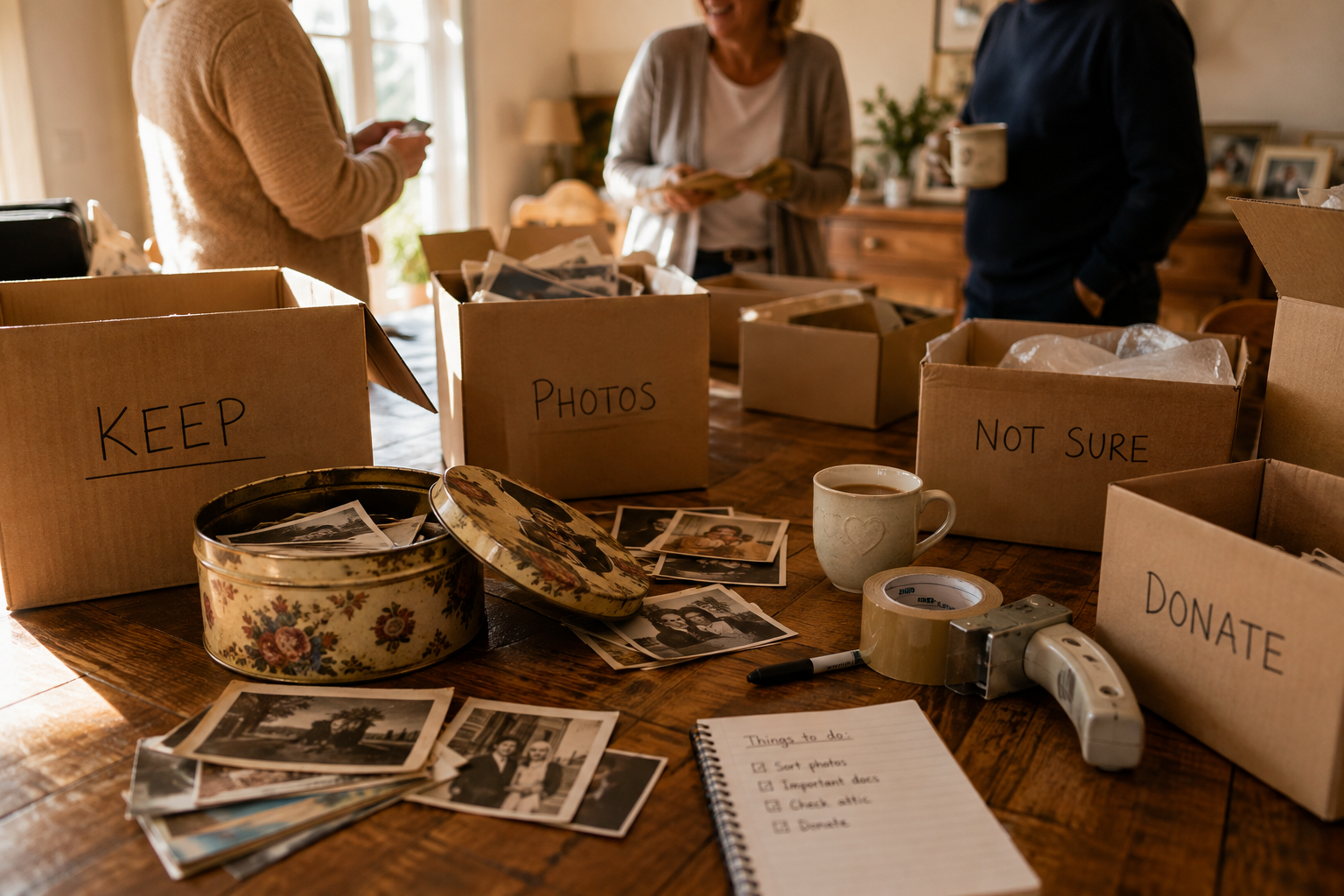
By this stage, the dining room has disappeared beneath carefully labelled boxes, the kitchen counters are home to several “keep”, “donate” and “not sure yet” piles, and someone has almost certainly lost the roll of packing tape for the third time.
The optimism that filled the house first thing in the morning has faded slightly, replaced by the realisation that a lifetime doesn’t fit neatly into cardboard boxes. Looking around can feel overwhelming because you’re no longer sorting cupboards; you’re sorting decades. Every shelf represents another chapter, every wardrobe another season of life, and every room quietly reminds you just how much living has taken place within those four walls. It is no wonder people reach the point where they feel they have barely made a dent.
Ironically, that is often the moment when the biggest breakthrough happens. Once everyone accepts that the house won’t be emptied in an afternoon, the pressure eases. Conversations become lighter again. Decisions come more naturally because nobody is trying to race against an impossible deadline.
The laughter returns, not because the work has become easier, but because people stop expecting perfection from themselves. There is something wonderfully freeing about admitting that a family home deserves more than a hurried goodbye. Of course, just as the atmosphere settles, somebody discovers another box tucked away on the top shelf of a cupboard.
The entire family gathers around as though a long-lost treasure chest has been unearthed. The box is opened with great anticipation, only to reveal dozens of tangled charging cables, three lonely curtain hooks, an instruction manual for a microwave that vanished years ago and enough batteries to power a small village—none of which actually work.
Everyone laughs, someone shakes their head, and another family member proudly declares that they knew those cables would come in handy one day. I have come to believe that every family has one cupboard that exists purely to test our optimism.
Then there is my personal favourite, because it appears so late in the day and with such remarkable confidence.
As amusing as these familiar phrases are, I’ve realised they’re rarely about the belongings themselves. More often, they’re about people trying to slow down time, even if only for a little while. Every hesitant decision, every postponed box and every rescued object may be another way of saying, “I’m not quite ready to let this part of my life go.”
Once I began looking at it that way, I found myself becoming far more patient. A chipped teacup might bring back Sunday afternoons with Gran. An old garden fork might remind someone of weekends spent alongside Dad. Those stories were never really stored inside the cupboards. They lived in the people standing around them.
That is why I’ve never believed a successful home transition is measured only by how many boxes leave the house. Of course, there is satisfaction in seeing rooms become lighter and knowing another chapter is beginning, but the conversations along the way matter just as much. Families may forget how many trips they made to the charity shop, but they’ll often remember the laughter, the unexpected discoveries and the stories that came tumbling out of forgotten drawers.
Looking back, I can’t remember every house I’ve helped to empty, but I remember the people. I remember the family members laughing over mysterious kitchen gadgets, the grandchildren discovering old photographs and the unexpected little treasures that brought everyone together for a moment.
Those are the memories that stay with me. Homes are never just buildings. They are quiet keepers of ordinary lives that become extraordinary when someone takes the time to notice.
So, if you ever find yourself standing in the middle of a family home surrounded by boxes, bubble wrap and far more plastic containers than any household could reasonably need, don’t be surprised when someone says, “Don’t throw that away,” or “We’ll sort it later.” Smile, pour another cup of tea and enjoy the conversation that follows. One day, those familiar phrases may become part of your family’s story too, and I have a feeling you’ll laugh about them for years to come.
A family home is filled with memories as much as belongings. Even everyday objects can remind us of people, traditions and special moments, making decisions far more emotional than we expect.
Allow plenty of time, listen to one another’s memories and accept that different people attach different meanings to the same belongings. Patience and a sense of humour often go much further than trying to rush decisions.
Photograph meaningful items before donating them, choose a few special keepsakes that truly matter and share the stories behind them with younger family members. The memories are often more valuable than the objects themselves.
Absolutely. Laughter is a natural part of remembering people we love. It doesn’t diminish the emotional moments; it often helps us through them and creates new memories alongside the old ones.
Keep the items that genuinely mean something to you or serve a purpose in your life today. It’s perfectly all right to let go of belongings while holding tightly to the memories they represent.
Clearing a family home can bring up all sorts of emotions, and having a few practical items close at hand can make the process feel a little less overwhelming. When you’re sorting through years of belongings, simple things like sturdy boxes, labels and somewhere safe to keep treasured memories can make a real difference.
Some of the items below may be helpful if you’re preparing for a home clear-out or helping a loved one move into a smaller space.
If you’re helping ageing parents downsize, clearing a family home or simply trying to bring a little more calm into your own space, these related Rustic Daisy articles may offer some gentle guidance and practical ideas along the way.
The Best Way To Organise Important Family Documents – Before you pack another box, make sure your family’s most important paperwork is organised and easy to find. This guide will help you create one place for everything that really matter
What To Keep When You Can’t Keep Everything – One of the hardest parts of any home transition is deciding what stays and what goes. If you’re struggling with sentimental belongings, this article may help make those decisions feel a little gentler.
25 Things You Can Declutter Today Without Regret – Need an easy place to start? These everyday items can usually leave your home without any second thoughts, giving you confidence to tackle bigger decisions later.
Creating A Cosy Home After Life’s Major Transitions – Once the boxes are unpacked, it’s time to make your new space feel like home. Here are some simple ways to create warmth, comfort and a fresh beginning.
How Family Dynamics Affect Downsizing Decisions – Every family approaches change differently. Understanding those dynamics can make difficult conversations much easier and help everyone feel heard.
Thank you so much for spending a little time with me today. If this article brought back memories, made you smile or reminded you that your family isn’t the only one with a cupboard full of mystery cables and biscuit tins, then I’m so glad you stopped by.
Here at Rustic Daisy, I believe our homes tell the story of our lives. Whether you’re helping ageing parents, starting over, downsizing, decluttering or simply trying to create a little more peace at home, I hope you’ll find encouragement, practical ideas and a friendly voice waiting for you here.
Put the kettle on, have a look around and stay awhile. There’s always another story to share.
With love,