

There are certain conversations in life that leave you feeling as though you have accidentally walked into a meeting for which nobody bothered to send you the agenda.
You begin with a perfectly ordinary sentence, perhaps something as harmless as, “That wasn’t very nice,” and somehow, fifteen minutes later, you are discussing your personality, your communication skills, your childhood, your attitude and possibly your general suitability as a human being.
You may even find yourself apologising by the end of it. For what, exactly? You are no longer entirely sure. Somewhere between mentioning that your feelings were hurt and being told that you are “too sensitive”, the original conversation has disappeared completely.
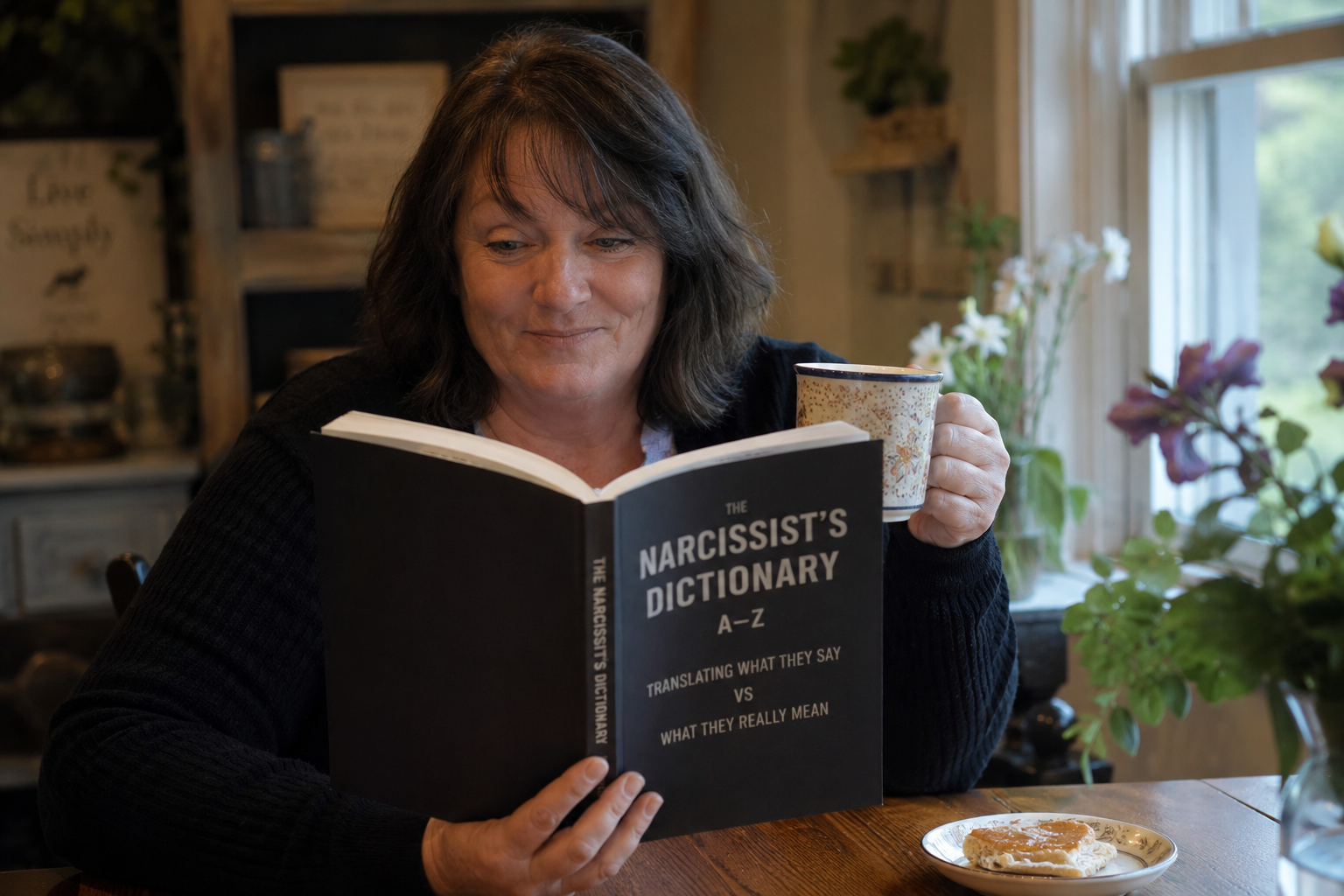
This is where Part 1 of the Narcissist’s Dictionary comes in. I think every household should have a copy of The Narcissist’s Dictionary. It would be a small, practical book containing helpful translations for those moments when somebody says one thing but somehow means something quite different.
It would probably be particularly useful at family gatherings, in romantic relationships, in some friendships and also, during those wonderfully complicated conversations where you start by discussing who forgot to buy milk and end up defending your entire character.
Naturally, this isn’t a medical dictionary and it certainly isn’t intended to diagnose anybody. People can be selfish, defensive, insecure, thoughtless or simply be having a spectacularly bad Tuesday without having narcissistic personality disorder.
We’re simply having a little fun with some familiar phrases that can crop up when you’re dealing with someone who has a particularly strong need to be right, admired, in control or completely exempt from anything resembling personal responsibility.
Think of it as subtitles for difficult conversations because sometimes, once you understand what is actually happening underneath the words, the conversation becomes considerably less confusing.
And, if nothing else, perhaps you’ll get a little chuckle out of some of the more creative ways people can avoid saying, “Yes, I probably handled that badly.”
What they say: “You’re overreacting.”
What they may mean: “I would prefer it if your feelings didn’t interfere with my behaviour.”
This is one of those phrases that can make a perfectly reasonable person start wondering whether they have accidentally become far too emotional about absolutely everything.
You mention that something hurt your feelings and suddenly the discussion isn’t about what happened at all. Instead, it has become a detailed examination of your emotional constitution. Apparently the offence itself has wandered off for a cup of tea while everyone discusses whether you are perhaps a little too sensitive.
Before long, you can find yourself wondering whether having feelings now requires some sort of official permit.
Of course, sometimes we do overreact. We are human. I have yet to meet a person who has handled every disagreement with the calm wisdom of a Buddhist monk.
Most of us have had moments when something tiny became disproportionately irritating. There are days when somebody leaving an empty milk bottle in the fridge feels like a personal attack on the entire institution of civilisation.
That doesn’t mean every emotional reaction is automatically reasonable but being sensitive does not automatically mean being wrong. Sometimes something genuinely hurt. Sometimes a comment was unnecessarily cruel. Sometimes someone’s behaviour really did cross a line.
If the easiest way for another person to avoid discussing what they did is to make your feelings the problem, then perhaps the phrase “You’re too sensitive” deserves its place in our little dictionary.
What they say: “Can’t you take a joke?”
What they may mean: “I would like to say something unpleasant without having to accept responsibility for saying it.”
Ah, the emergency exit of difficult conversations. There are few phrases more useful to someone who has just discovered that their hilarious comment wasn’t quite as hilarious as they imagined. “I was only joking” can appear with astonishing speed, particularly after a remark that would have been considerably less funny if it had been printed on a birthday card.
There is, of course, a perfectly healthy place for teasing. Friends and family members who know each other well can say ridiculous things to one another and laugh until somebody nearly chokes on their tea. That sort of humour has warmth behind it. Everyone understands the joke and nobody is being deliberately diminished to make someone else feel bigger.
Then there is the other sort. One person makes the comment, another person goes quiet and suddenly the room develops the atmosphere of a dentist’s waiting room. When the person who was targeted doesn’t laugh, they are told they cannot take a joke. It is a remarkably convenient arrangement because the person making the joke gets to decide that it was funny while the person on the receiving end gets blamed for failing to appreciate the comedy.
There is actually a rather simple test for this. If everyone is laughing together, it is probably a joke. If one person is laughing while another person is trying to work out why they suddenly feel about three inches tall, perhaps it wasn’t quite as harmless as advertised. And if the punchline requires the other person to feel bad about themselves, followed by an explanation that they are simply too sensitive for not enjoying it, our dictionary may reasonably translate the whole exchange as, “I don’t want to take responsibility for what I just said.”
What they say: “That never happened.”
What they may mean: “I don’t want to discuss your version of events.”
This phrase can be particularly unsettling because it invites you to question your own memory. You remember the conversation. You remember roughly where you were standing. You may even remember what you were wearing and the expression on the other person’s face. Then somebody confidently tells you that the conversation never happened, and suddenly you are mentally replaying the entire incident like a detective who has misplaced the evidence.
Did they say it? Did you misunderstand? Was it Tuesday or Wednesday? Did you actually have that conversation or did your brain create a completely unnecessary side plot while you were making dinner?
It is remarkable how quickly certainty can turn into confusion when someone repeatedly insists that your recollection is wrong. This is why it can be useful to trust your own memory without feeling that you have to prove every detail beyond reasonable doubt. You don’t need a courtroom, three witnesses and a security camera to know that something felt wrong. Sometimes you simply know what you heard, what you saw and how the interaction made you feel.
And there is no prize for successfully arguing about it for three hours.
That may be one of the more useful lessons hidden inside this particular dictionary. Not every disagreement needs to be won. Sometimes the healthiest response is simply to recognise that two people remember an event differently and decide that you are not going to spend the rest of the afternoon trying to convince somebody of something they have already decided they don’t want to acknowledge.
Your sanity is worth more than winning an argument about whether the conversation happened at 2.15 or 2.20.
What they say: “Nobody agrees with you.”
What they may mean: “I would like you to believe that other people agree with me.”
The word “everyone” does an astonishing amount of work in difficult conversations. Everyone thinks this. Everyone agrees. Nobody likes that. People are saying things about you. Once the word has been introduced, it can make an opinion sound as though it has been carefully researched by a committee and approved unanimously.
The problem is that “everyone” is remarkably difficult to locate.
Who exactly is everyone? Suddenly the committee members become rather mysterious. Sometimes “everyone” turns out to be one person, one disgruntled acquaintance and somebody who apparently said something three years ago but cannot now be reached for comment. By this point, you may feel as though you should issue a press statement.
Most of us naturally care about how other people see us. Nobody particularly wants to be told that they are the difficult one in the family, the friendship group, the workplace and possibly the entire neighbourhood. But the truth is that being disliked by someone doesn’t automatically make you difficult, just as being adored by someone doesn’t automatically make you right.
We all have moments when we are difficult. Some of us have entire afternoons. We can be tired, impatient, stubborn, opinionated and occasionally quite unreasonable, usually before lunch. That is part of being human. The important thing is not whether everyone approves of us. It is whether we are willing to look honestly at our own behaviour without allowing someone else to use a vague collection of imaginary voters to make us doubt ourselves.
“Everyone thinks you’re difficult” is not evidence. It is an opinion wearing a rather impressive hat.
What they say: “The problem is you.”
What they may mean: “I would like us to discuss your behaviour instead of mine.”
This may be one of the more spectacular conversational reversals. You raise a concern about somebody’s behaviour and suddenly the spotlight swings around and lands directly on you. You arrived to discuss something they did and, before you know it, you are discussing your personality, your communication style and whether you have perhaps been the problem all along.
It is rather like taking your car to the mechanic because the brakes are making an alarming noise and being told that the real issue is your choice of music. You may eventually agree to discuss the music. You might even become quite invested in the music. Meanwhile, the brakes remain suspiciously broken.
It is worth saying again that having a selfish moment does not make somebody a narcissist. None of us would survive that test. We have all occasionally wanted the biggest slice of cake, the last word, the best seat or the parking space closest to the entrance when it is raining. There are moments when we all think we are slightly more important than everyone else, particularly when we have been waiting twenty minutes for someone who said they would “just be five minutes”.
The interesting part is what happens when every attempt to discuss someone’s behaviour somehow becomes an examination of yours. If every concern is met with an accusation, the original issue can disappear completely. Suddenly you’re defending yourself rather than discussing what happened in the first place.
And that is a very clever conversational trick, whether it is deliberate or not.
What they say: “This is a pattern.”
What they may mean: “I would like to make this particular disagreement about your entire personality.”
The word “always” should probably come with its own warning label. So should “never”. These two little words have an extraordinary ability to turn one small disagreement into a historical documentary.
You forget to answer one message and apparently you have spent your entire adult life ignoring people. You disagree once and suddenly you never listen. You object to something and somehow you have become impossible. You can almost hear the filing cabinets opening as evidence from 2007 is retrieved and placed on the table for consideration.
This is where conversations can become exhausting because you find yourself trying to defend every allegation instead of dealing with the original problem. Suddenly you are explaining what happened three birthdays ago, why you didn’t answer a phone call last winter and whether you really did roll your eyes at dinner six months ago.
By the time you’ve finished, you have completely forgotten why the conversation started.
There is something rather liberating about refusing to be dragged into the entire historical archive. A person can make mistakes without needing to defend their entire personality, and a disagreement about one incident doesn’t necessarily require a review of every questionable decision made since the invention of the microwave.
Sometimes the healthiest thing you can do is bring the conversation back to the matter at hand. Not because you are avoiding accountability, but because you are refusing to turn one ordinary disagreement into a full-scale investigation into your character.
After all, if every argument requires evidence from the last twenty years, you may need to start taking minutes.
And nobody has time for that.
The strange thing about these conversations is that they can leave perfectly sensible people feeling completely muddled. You started with a simple concern and somehow ended up defending yourself against a list of charges you didn’t even know existed. Once you begin recognising these patterns, however, the confusion can lessen. You don’t necessarily need a perfect response, a clever comeback or the final word. Sometimes simply recognising what is happening is enough to stop yourself being pulled into the same conversation again and again.
And thankfully, our imaginary dictionary has plenty more entries to get through.
Not necessarily. People sometimes say “you’re too sensitive” because they genuinely see a situation differently or don’t understand why something was hurtful. However, if someone repeatedly dismisses your feelings instead of being willing to discuss what happened, it can become part of an unhealthy communication pattern.
“I was only joking” can sometimes be a genuine explanation after harmless teasing. However, when it regularly follows an insulting or hurtful comment, it can be a way of avoiding responsibility for what was said. The important thing is to look at the wider pattern rather than judging someone from one phrase.
Gaslighting is a pattern of manipulation that can cause someone to question their own memories, perceptions or understanding of events. Simply remembering an event differently from another person is not automatically gaslighting. Repeatedly denying things that happened or deliberately making someone doubt their own reality can be more concerning.
The word “everyone” can make one person’s opinion sound like a widely held belief. In reality, it may represent only one person’s perspective. If someone repeatedly uses other people’s supposed opinions to dismiss or discredit you, it can be helpful to ask yourself whether there is any actual evidence behind the claim.
If this article has reminded you of someone in your own life, you may find it helpful to have a few gentle resources nearby. These are not magic solutions and they certainly cannot change another person’s behaviour, but sometimes the right book, journal or small comfort can help you feel a little less alone while you work out what you need.
The Gaslight Effect Recovery Guide- Dr Robin Stern – This book is a must-read if you are suffering from emotional abuse. It’s a journey towards healing and understanding.
Set Boundaries, Find Peace: A Guide to Reclaiming Yourself by Nedra Glover Tawwab – A must read for anyone struggling with boundaries. This book really helped me.
The Body Keeps the Score: Brain, Mind, and Body in the Healing of Trauma – A must-read for understanding trauma and healing!
When Things Fall Apart: Heart Advice for Difficult TimesThis book is the perfect read when you need some comfort and guidance.
Memory journal – This journal helps to remember and heal. Perfect for those who lost someone dear.
Daily gratitude journal – I love starting my day with a little gratitude practice. This journal makes it super easy!
Weighted blanket – This weighted blanket will help you sleep better. It’s super soft and cooling too!
Herbal tea gift box – This tea gift set is perfect for relaxing. It includes a beautiful ceramic cup.
Self-care gift basket – This care package is perfect for anyone who needs a little comfort and positivity!
Adult colouring book – These adult coloring books will help you relax and find inner peace.
Colouring pens – These markers are perfect for coloring, sketching, and journaling! They have a dual tip so you can switch between a fine tip and a brush pen.
Some of the products mentioned in this article may contain affiliate links. If you choose to purchase through one of these links, Rustic Daisy may receive a small commission at no additional cost to you. I only recommend products that I believe may be genuinely useful to my readers. Thank you for supporting The Rustic Daisy
Emotional manipulation rarely exists on its own. Many people who experience gaslighting also struggle with difficult family relationships, narcissistic behaviour and unhealthy boundaries. If you’re beginning to recognise these patterns, you may also find these articles helpful as you continue your healing journey.
Part 2 of The Narcissist’s Dictionary
Part 3 of The Narcissist’s Dictionary
Does a narcissist know that they are a narcissist?
The most powerful healing happens in silence
Behaviours narcissists can’t hide forever
Creating a cozy home after a major life transition
The day I stopped explaining myself
My best friend is a narcissist. What now?
Some seasons of life teach us to speak up. Others teach us that we don’t have to explain ourselves quite so much. Either way, I hope you find a little more peace, a little more confidence and perhaps a good cup of tea along the way.
With warmth,