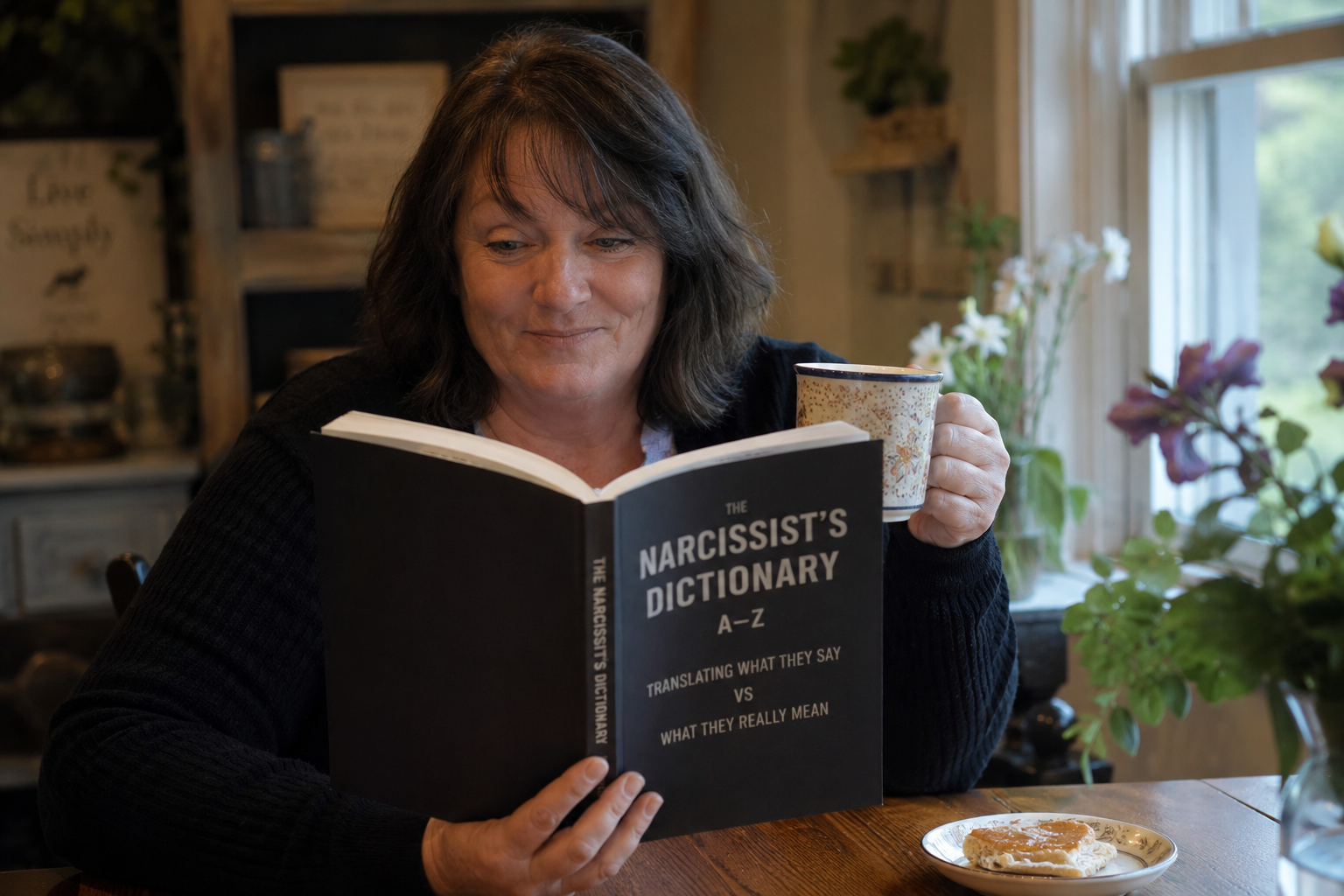
In Part 1, we opened the rather unofficial Narcissist’s Dictionary and started translating some of those wonderfully confusing phrases that can turn an ordinary conversation into something resembling a parliamentary inquiry. We looked at “You’re too sensitive”, “I was only joking”, “You’re imagining things”, “Everyone thinks you’re difficult”, “You’re the narcissist” and the ever-useful “You always do this”, discovering how quickly a simple disagreement can become an unexpected investigation into your entire character.
Thankfully, we still have plenty of entries left in the dictionary. So, if you’ve ever received an apology that somehow wasn’t an apology, been reminded of everything someone has ever done for you since the invention of electricity or been informed that absolutely nobody appreciates them, pour yourself another cup of tea. Our translations continue in Part 2 of The Narcissist’s Dictionary.
What they say: “I’m acknowledging your feelings.”
What they may mean: “I am not accepting any responsibility for why you have them.”
This phrase is fascinating because, at first glance, it sounds like an apology. It contains the word “sorry”, after all, and most of us were raised to believe that when someone says sorry, some sort of responsibility is about to follow. Unfortunately, “I’m sorry you feel that way” is often less of an apology and more of a polite little escape hatch.
Notice what is missing.
There is no “I’m sorry I said that.” There is no “I shouldn’t have treated you like that.” There is no “I can see why that hurt you.” Instead, the responsibility has quietly been transferred from the person who did something to the person who experienced it. You have feelings. They are your feelings. Therefore, apparently, the problem has been successfully returned to sender.
It is a little like someone stepping on your foot and saying, “I’m sorry your foot is experiencing this.”
Thank you.
That is tremendously helpful.
Of course, there are perfectly innocent situations where someone genuinely doesn’t understand why you are upset and is trying to acknowledge your feelings without agreeing with your interpretation. Context matters. But when the phrase appears every single time someone is asked to take responsibility, it starts to sound less like empathy and more like a carefully worded legal statement.
The useful translation is therefore not necessarily, “This person is definitely a narcissist.” It is simply, “My feelings have been acknowledged, but the actual issue remains completely untouched.”
Which brings us neatly to another classic.
What they say: “I’ve apologised.”
What they may mean: “I would like this conversation to end immediately, preferably without any further discussion of my behaviour.”
There is a particular kind of apology that feels rather like someone putting a plaster over a leaking tap and then becoming irritated when the floor remains wet.
“I said sorry!”
And there you are, still sitting with the original problem.
A genuine apology doesn’t necessarily require an enormous emotional speech, a violinist in the corner or a handwritten letter sealed with wax. Sometimes “I was wrong. I’m sorry. I shouldn’t have done that” is perfectly sufficient. The difference is that a meaningful apology generally includes some recognition of what actually happened.
The problem with the dramatic “What more do you want?” version is that it can make you feel unreasonable for wanting the conversation to have some sort of resolution. You may begin thinking, Perhaps I am asking too much.
Maybe you are.
Maybe you are asking for the extraordinary luxury of someone understanding why their behaviour was hurtful and making an effort not to repeat it.
How demanding.
What they say: “Your behaviour caused my reaction.”
What they may mean: “I would rather explain my behaviour than take responsibility for it.”
This phrase has been around for so long that it deserves its own little brass plaque.
“You made me angry.”
“You pushed me to it.”
“If you hadn’t done that, I wouldn’t have reacted.”
It is a very convenient arrangement because it places responsibility for one person’s actions neatly into somebody else’s lap.
Of course, other people’s behaviour can influence how we feel. Someone can irritate us, disappoint us, frighten us or make us extremely tempted to throw a cushion across the room. But there is still a difference between being provoked and being responsible for what we choose to do next.
Otherwise, every unpleasant behaviour could be explained away by pointing at someone else.
“I only shouted because you annoyed me.”
“I only insulted you because you disagreed with me.”
“I only behaved terribly because you made me.”
At this rate, nobody is responsible for anything.
It would make life wonderfully simple. We could all wander around leaving chaos behind us while pointing at other people and saying, “Well, technically, this is your fault.”
Sadly, adulthood doesn’t quite work that way.
What they say: “You’re the first person to complain.”
What they may mean: “Therefore, your complaint must be the problem.”
This one sounds quite convincing until you think about it for more than thirty seconds.
Someone can go through twenty years of friendships, relationships or working life without anybody confronting them about a particular behaviour for all sorts of reasons. People avoid conflict. People keep quiet. People make excuses. People don’t want to rock the boat. Some people simply leave.
So the absence of complaints isn’t necessarily proof of excellent behaviour.
It may simply mean that nobody wanted to have the argument.
There is also something wonderfully convenient about declaring yourself completely problem-free because nobody has previously complained. It is rather like saying, “Nobody has ever told me that I snore, therefore I definitely don’t.”
Meanwhile, everyone else in the house is sleeping with a pillow over their head.
Healthy relationships don’t require us to have a perfect history. They require us to be capable of hearing when something hasn’t gone well and considering whether there is something we could have done differently.
Sometimes the person giving us difficult feedback is wrong.
Sometimes they are right.
The ability to consider the possibility is the important bit.
What they say: “You don’t like my success.”
What they may mean: “I would rather assume your motives than listen to your concern.”
This can be a particularly handy phrase when somebody doesn’t want to discuss why you are uncomfortable with something they have done.
Perhaps you question their behaviour.
Perhaps you disagree with a decision.
Perhaps you point out something that doesn’t sit comfortably with you.
Suddenly you are jealous.
Apparently the only possible explanation for your objection is that you secretly wish to be them.
This can be especially amusing when the subject matter is something you genuinely have no interest in whatsoever.
“No, honestly, I don’t want your life.”
“You’re just jealous.”
“I really don’t.”
“You definitely are.”
At that point, there seems little value in continuing.
One of the peculiar things about being told what your motives are is that the other person can become so certain about what you are thinking that there is almost no room left for you to explain yourself.
You know your own reasons.
They have apparently received the director’s cut.
What they say: “I feel unappreciated.”
What they may mean: “I would like the things I have done to become a permanent credit against anything I do wrong.”
This one can be complicated because gratitude really does matter. We should appreciate kindness. We should notice when people help us. We should say thank you when someone goes out of their way for us.
But kindness becomes rather different when it is repeatedly presented as an invoice.
“I did this for you.”
“I paid for that.”
“Remember when I helped you?”
“You wouldn’t have managed without me.”
Suddenly the favour has acquired interest.
It is like receiving a free coffee and discovering six months later that you apparently owe somebody a car.
Healthy generosity doesn’t usually require a running scoreboard. If I bring you soup when you’re sick, I hope you appreciate the soup. I don’t expect to be able to use that soup as evidence in every future disagreement.
Imagine if we did that with everything.
“Yes, I understand you’re upset, but I once lent you my lawnmower in 2019.”
It would make family meetings absolutely exhausting.
Of course, genuine relationships involve give and take. There will be times when one person does more than the other. Life isn’t an accounting spreadsheet. But when past kindness is repeatedly used to silence present concerns, the kindness starts to feel rather less like generosity and rather more like leverage.
What they say: “You owe me.”
What they may mean: “Your disagreement is unacceptable because I have accumulated credits.”
This is the more advanced version of the previous phrase, usually delivered with a sigh heavy enough to move curtains.
“After everything I’ve done for you…”
Those words can make a person immediately review their entire life.
You begin mentally listing everything the other person has ever done for you, including things you had forgotten about.
They bought you lunch in 2017.
They helped you move house.
They once picked you up from the airport.
They sent you a birthday message.
They apparently deserve a lifetime of unquestioning agreement as a result.
This is where gratitude and obligation can become confused. Being grateful to somebody doesn’t mean you surrender your right to disagree with them. Appreciating someone’s help doesn’t mean you have to accept poor treatment indefinitely.
You can be grateful and still have boundaries.
You can love someone and still disagree with them.
You can appreciate everything someone has done for you and still say, “That wasn’t okay.”
Those things can exist together.
It would be wonderfully convenient if every relationship came with a neat receipt showing exactly how much gratitude was owed, but thankfully human relationships are not supermarkets.
Although, judging by some conversations, there are people who would quite like them to be.
What they say: “I do everything.”
What they may mean: “I would like recognition, sympathy and possibly a small award.”
This phrase often appears when someone feels unappreciated, and sometimes there really is a genuine imbalance that needs discussing. Household responsibilities, emotional labour, financial contributions and practical tasks can become uneven, particularly in families and long-term relationships.
The problem comes when the statement is presented not as an invitation to solve the problem but as a dramatic opening statement in the prosecution of everybody else.
“I am the only person who does anything around here.”
Really?
Nobody else has ever emptied the dishwasher?
Nobody has ever taken the rubbish out?
Nobody has ever bought toilet paper?
That last one is particularly unlikely.
The funniest part is that these conversations can become competitions over who has suffered the most. One person produces their list of contributions, the other produces theirs, and before long everyone is keeping score like it is the final round of the Household Olympics.
Sometimes the answer really is to sit down and divide responsibilities more fairly.
But sometimes the bigger issue is the expectation that everyone should automatically recognise how much one person does while that person never has to acknowledge what anyone else contributes.
And that brings us to another favourite phrase.
What they say: “I feel unsupported.”
What they may mean: “I would like everyone to notice my sacrifices without being asked.”
There is a big difference between saying, “I’m feeling overwhelmed and I could really use some help,” and announcing that nobody has ever done anything for you since the dawn of civilisation.
The first is a request.
The second is a production.
There may even be dramatic sighing.
Possibly a hand placed against the forehead.
Perhaps a long stare out of the window while the violins begin somewhere in the distance.
Again, sometimes people genuinely are overwhelmed and need support. There is nothing wrong with saying so. In fact, being able to ask for help is one of the healthiest things we can learn to do.
But if every situation becomes evidence that nobody appreciates, helps, notices or understands one particular person, eventually everyone else can find themselves walking on eggshells trying to prove that they care.
And that is exhausting.
There is a much simpler way of handling many of these situations: say what you need.
“I need some help with this.”
“I feel like I’m carrying too much.”
“Could you please take care of this?”
It isn’t nearly as dramatic.
But it has one enormous advantage.
It might actually solve the problem.
By now, you may have noticed something about our imaginary dictionary. The phrases themselves are not necessarily the problem. Most of them can be perfectly ordinary things to say in a healthy relationship. People genuinely get hurt. People genuinely feel unappreciated. People genuinely become defensive. People genuinely make mistakes.
The clue is often what happens next.
Can the person have a conversation about it?
Can they listen?
Can they consider another point of view?
Can they admit that they might have handled something badly?
Can both people eventually return to the original issue instead of turning it into a referendum on one person’s entire character?
Those are the moments that tell us considerably more than any single sentence ever could.
And, fortunately for our little dictionary, there are still a few particularly impressive entries waiting for us in Part 3.
It can be an attempt to acknowledge someone’s feelings, but it does not necessarily accept responsibility for what happened. There is a significant difference between “I’m sorry you feel that way” and “I’m sorry I hurt you.” The second statement acknowledges the person’s own behaviour.
People sometimes use this phrase when they feel genuinely provoked or overwhelmed. However, nobody else’s behaviour completely removes our responsibility for how we choose to respond. Being angry is a feeling, while what we do with that anger remains our responsibility.
Yes. Kindness and generosity can become unhealthy when past favours are repeatedly brought up to create a sense of debt or obligation. Appreciating what someone has done for you does not mean you must agree with everything they say or accept behaviour that makes you uncomfortable.
No. People often avoid confrontation, keep quiet about problems or simply walk away from difficult relationships. The absence of previous complaints does not necessarily prove that someone’s behaviour has always been healthy.
If this article has reminded you of someone in your own life, you may find it helpful to have a few gentle resources nearby. These are not magic solutions and they certainly cannot change another person’s behaviour, but sometimes the right book, journal or small comfort can help you feel a little less alone while you work out what you need.
The Gaslight Effect Recovery Guide- Dr Robin Stern – This book is a must-read if you are suffering from emotional abuse. It’s a journey towards healing and understanding.
Set Boundaries, Find Peace: A Guide to Reclaiming Yourself by Nedra Glover Tawwab – A must read for anyone struggling with boundaries. This book really helped me.
The Body Keeps the Score: Brain, Mind, and Body in the Healing of Trauma – A must-read for understanding trauma and healing!
When Things Fall Apart: Heart Advice for Difficult TimesThis book is the perfect read when you need some comfort and guidance.
Memory journal – This journal helps to remember and heal. Perfect for those who lost someone dear.
Daily gratitude journal – I love starting my day with a little gratitude practice. This journal makes it super easy!
Weighted blanket – This weighted blanket will help you sleep better. It’s super soft and cooling too!
Herbal tea gift box – This tea gift set is perfect for relaxing. It includes a beautiful ceramic cup.
Self-care gift basket – This care package is perfect for anyone who needs a little comfort and positivity!
Adult colouring book – These adult coloring books will help you relax and find inner peace.
Colouring pens – These markers are perfect for coloring, sketching, and journaling! They have a dual tip so you can switch between a fine tip and a brush pen.
Some of the products mentioned in this article may contain affiliate links. If you choose to purchase through one of these links, Rustic Daisy may receive a small commission at no additional cost to you. I only recommend products that I believe may be genuinely useful to my readers. Thank you for supporting The Rustic Daisy
Emotional manipulation rarely exists on its own. Many people who experience gaslighting also struggle with difficult family relationships, narcissistic behaviour and unhealthy boundaries. If you’re beginning to recognise these patterns, you may also find these articles helpful as you continue your healing journey.
Part 1 of The Narcissist’s Dictionary
Part 3 of The Narcissist’s Dictionary
What are healthy family boundaries
Does a narcissist know that they are a narcissist?
The most powerful healing happens in silence
Creating a cozy home after a major life transition
The day I stopped explaining myself
My best friend is a narcissist. What now?
Some seasons of life teach us to speak up. Others teach us that we don’t have to explain ourselves quite so much. Either way, I hope you find a little more peace, a little more confidence and perhaps a good cup of tea along the way.
With warmth,