

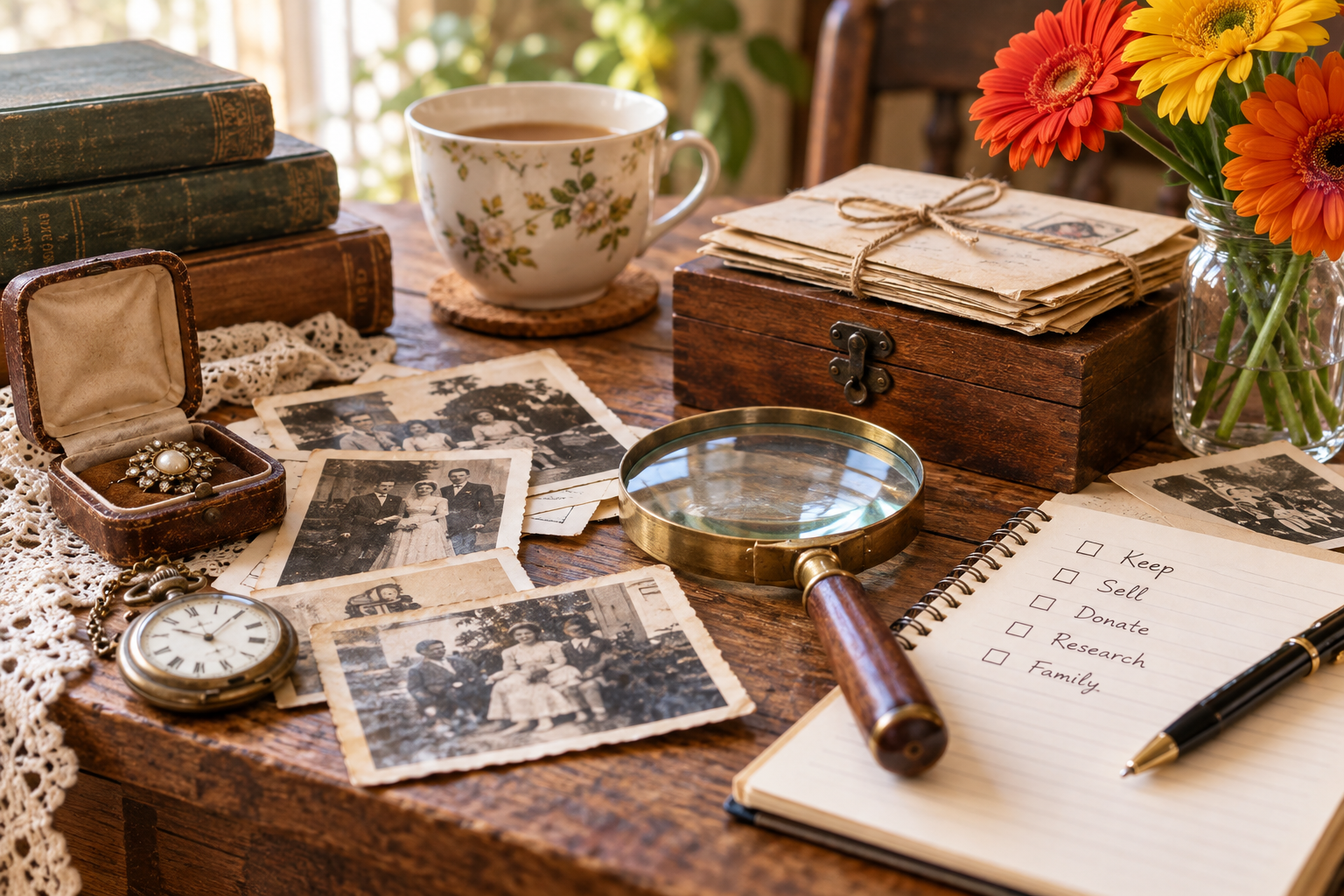
By now, if you have been following this series, you may be looking at the contents of your cupboards, bookshelves and old storage boxes a little differently. What once seemed like a collection of ordinary belongings may now have you wondering whether there is something worth keeping, selling or researching before it leaves your home. And that is exactly the point of taking a little extra time before donating.
But discovering that an item might be valuable is only the beginning. How do you research it properly? When is it worth asking a professional for advice? And how do you decide whether selling something is worthwhile, especially when you are already dealing with the emotional and practical demands of downsizing or clearing a family home?
In this final part of our series, we will look at how to make those decisions with a little more confidence. We will explore where to begin your research, when a professional valuation may be helpful and how to recognise the difference between something that has financial value and something that holds a special place in your family’s story.
Because knowing what is valuable before donating is not about turning every old possession into a potential payday. It is about making informed choices, avoiding unnecessary regrets and giving ourselves the time to decide what deserves to be kept, passed on, sold or donated. Sometimes the wisest decision is to sell an item, sometimes it is to give it a new home and sometimes it is simply to hold on to something that means more to us than any price tag ever could.
When we think about valuable possessions, our minds often go straight to jewellery, antiques and collectables. But some of the most important things to check before donating or decluttering are not objects at all. They are the papers tucked into filing cabinets, old handbags, desk drawers and dusty boxes that may have been sitting untouched for years.
When helping to clear a family home, it can be tempting to treat old paperwork as clutter. After all, who wants to spend an afternoon sorting through envelopes, certificates and documents that nobody has looked at in decades? Yet some of those papers may contain information that is financially valuable, legally important or simply impossible to replace.
Before throwing away or donating old paperwork, take time to look for documents such as:
If you come across unfamiliar financial documents, avoid discarding them until you have established what they relate to. In South Africa, older investment or shareholding records may require enquiries with the relevant company, transfer secretary or financial institution. A document’s age does not automatically mean that it still represents a financial asset, but it is worth checking before making that decision.
Property-related documents deserve similar care. If you are clearing the home of an elderly parent or a loved one who has passed away, keep potentially relevant paperwork together until the estate or property matters have been properly reviewed. An attorney, executor or other appropriate professional can help establish which documents need to be retained.
Family records can be just as meaningful, even when they have no financial value. An old passport showing where a grandparent travelled, a handwritten letter from a relative or a marriage certificate from generations ago may help preserve a family’s story. Before donating or disposing of these papers, consider whether another family member would appreciate having them.
It is also sensible to protect documents containing personal information. Old identity documents, financial statements and paperwork showing account details should not simply be placed in a donation box or left where others can access them. Store them securely while you determine whether they need to be retained, returned or disposed of safely.
If you discover documents that appear financially or legally significant, take clear photographs or make copies for reference, but keep the originals safe until you have received appropriate advice. Avoid writing on, laminating or altering original documents, as doing so may affect their usefulness.
The key is not to keep every scrap of paper forever. It is to pause before treating old documents as rubbish. A few minutes spent sorting through a forgotten folder could help protect a financial interest, preserve an important family record or prevent a very frustrating problem later.
There may come a point during decluttering when you realise that an item deserves more than a quick online search. Perhaps it is an unfamiliar piece of jewellery, an antique that has been in the family for generations or something that appears to be unusually well made. This is when a professional valuation can be worth considering. You do not need to have every old possession appraised, but getting expert advice on a potentially valuable item could save you from making an expensive mistake.
It is worth consulting a specialist when:
A professional valuation may be especially helpful when dealing with jewellery, watches, artwork, coins, silverware or specialist collectibles. An experienced valuer can sometimes identify details that are easy to overlook, such as the maker, age, materials or condition. They may also be able to explain whether an item has a realistic resale market or whether its value is primarily sentimental.
Before arranging a valuation, take a little time to research the person or business you plan to consult. Look for someone with experience in the particular type of item you have. An antique furniture specialist, for example, may not be the right person to assess a collection of rare coins. Ask about fees in advance and find out whether the valuation is intended for insurance, resale, estate administration or another purpose, as these values may differ.
It is also wise to understand that an estimated value is not necessarily the amount you will receive if you sell. A valuation may provide a useful guide, but the final selling price will depend on demand, the condition of the item, the selling platform and whether you are selling privately or through a dealer.
If you are sorting through a deceased estate or helping a parent downsize, consider setting aside potentially valuable items until you have had an opportunity to investigate them. Spending a little on expert advice may help you make a more informed decision about what to keep, sell or pass on to another family member.
After spending time researching old belongings, it can be a relief to realise that not everything needs a closer inspection. Most homes contain plenty of everyday items that have little resale value but could still be genuinely useful to someone else. Donating these things can make the decluttering process feel less overwhelming and help good-quality belongings find a new home.
Common household items that are often suitable for donation include:
These items may not have much financial value, but that does not mean they have no purpose. A young family setting up their first home may appreciate a sturdy dining table. Someone starting over may be grateful for kitchen essentials, while a charity shop may be able to sell donated books and household goods to support its work.
Before donating, give items a quick check for damage, missing parts, stains or anything that could make them unsuitable for another person. Different charities have different requirements, so it is worth checking what they accept before loading up the car. Some organisations may collect larger items, while others have limited storage space or cannot accept certain electrical goods.
If you are clearing a home in South Africa, consider local charity shops, community organisations, shelters or other groups that accept household donations. A quick phone call can save you an unnecessary trip and help ensure that your donations go somewhere they are needed.
Of course, an item being ordinary does not automatically mean it is worthless. If something has an unusual maker’s mark, an interesting history or features that make it stand out from similar items, take a moment to investigate it first. But once you are satisfied that there is no particular reason to hold it back, donating it can be a lovely way to let it serve someone else.
The aim is not to turn every cupboard into a research project. It is to recognise the difference between belongings that deserve a closer look and those that are ready to move on.
When we begin researching the possible financial value of our belongings, it is easy to become caught up in prices, resale listings and what an item might fetch. But not everything that matters can be measured in money. Some of the most precious things we own may have little commercial value, yet carry memories that are impossible to replace.
A handwritten recipe from your mother, a child’s drawing tucked inside an old book, a wedding photograph or a letter from someone who is no longer here may seem like small things to someone else. To you, they may hold an entire chapter of your life. These are the belongings that can catch us off guard when we are clearing a home, bringing back memories we had not thought about in years.
This is particularly important when helping an elderly parent downsize or sorting through a deceased estate. Family members may have different ideas about what should be kept, and it can be tempting to make quick decisions when there is a great deal to do. Whenever possible, give everyone involved an opportunity to identify items that hold personal meaning before anything is donated or sold.
You do not have to keep every sentimental possession to honour the memory attached to it. If there are boxes of photographs, letters or small keepsakes, you might choose a few favourites, create a memory box or take photographs of items that cannot realistically be kept. Some families enjoy sharing treasured objects among relatives, allowing different people to hold on to a small piece of their shared history.
It can also help to ask yourself what you value about a particular item. Is it the object itself, the person who gave it to you or the memory of a special time? Understanding that connection can make it easier to decide whether to keep the item, pass it on or find another way to preserve its story.
There is no need to rush these decisions. If something brings up strong emotions, set it aside and return to it another day. Decluttering is not simply about creating space; it is also about recognising what deserves a place in the next chapter of your life.
Sometimes the most valuable thing in a home is not something an expert can appraise. It is the little reminder of someone we loved, a moment we treasure or a story we want future generations to know.
One of the biggest mistakes people make when clearing a home is trying to do everything at once. Whether you are decluttering your own home, helping a parent downsize or preparing a family property for sale, it can quickly become exhausting when every cupboard, drawer and room seems to demand attention. Rushing can also lead to decisions you later regret, especially when valuable or sentimental items are mixed in with everyday belongings.
Instead of tackling the entire house in one weekend, work through one manageable area at a time. You might begin with a bookshelf, a kitchen cupboard or a single drawer. Smaller tasks are easier to complete, and each finished area gives you a little sense of progress without leaving you surrounded by the contents of the whole house.
As you sort, create clearly labelled piles or boxes for:
The “Unsure” pile can be particularly helpful when you are dealing with unfamiliar belongings. Rather than making a rushed decision about an old watch, a box of coins or a collection of books, set it aside and investigate it later. Keep a note of what you need to check so that these items do not disappear into a box and get forgotten.
If you are working through a large home, keep a simple record of items that may need further attention. A photograph, a note of the maker’s mark or model number and a brief description can make later research much easier. You do not need a complicated spreadsheet; even a notebook can help you keep track of what you have discovered.
It is also important to pace yourself emotionally. Clearing a family home can bring up memories, disagreements and unexpected feelings. Take breaks, involve family members where appropriate and avoid making irreversible decisions when you are tired or overwhelmed. If you are working to a deadline, prioritise the areas that need attention first and allow extra time for belongings that may need professional advice.
Remember that decluttering is not a race to empty a house as quickly as possible. It is a process of making thoughtful decisions about what comes with you, what can help someone else and what is ready to be released. Taking your time can protect you from costly mistakes and make the experience feel far more manageable.
Sometimes a slower approach is not only kinder to us; it is also the approach that allows us to notice the things we might otherwise have missed.
When we begin clearing a home, it is easy to focus on what needs to go. We look at crowded cupboards, overflowing bookshelves and boxes that have not been opened in years, wondering where on earth to begin. But taking the time to look more closely can change the way we approach the whole process. Some belongings may be worth researching or selling, others may be ready to donate and a few may hold memories that deserve to be preserved.
The purpose of this series has never been to suggest that every old possession is a hidden treasure. Most homes contain plenty of ordinary things, and there is nothing wrong with letting them go when they have served their purpose. The real value lies in making informed decisions rather than rushing through a lifetime of belongings and later wishing we had looked a little closer.
If you are helping a parent downsize, preparing a deceased estate or simply making room for a new chapter in your own life, give yourself permission to take things slowly. Ask questions, seek advice when needed and involve family members in decisions about items that may hold shared memories. You do not have to know the value of everything before you begin, and you certainly do not have to do it all in one day.
And remember, value comes in many forms. An antique that sells for a good price may be a welcome discovery, but so can the joy of donating a useful item to someone who needs it. A handwritten note or a family photograph may never have a resale value, yet it could be one of the most meaningful things you choose to keep.
As you work through your home, try to approach each decision with curiosity rather than pressure. You are not simply sorting objects. You are deciding what deserves a place in your next chapter and what can be given the opportunity to become part of someone else’s.
Start by identifying the item as accurately as possible. Look for maker’s marks, brand names, model numbers, dates or other identifying details. Search for the same or very similar items and compare their condition. Online listings can offer clues, but asking prices are not always the prices buyers actually pay. If an item appears particularly valuable or unusual, consider seeking advice from a specialist.
Online research can be a useful starting point, especially when you can find examples of the same item in a similar condition. However, prices can vary widely, and photographs or brief descriptions may not reveal important details. Treat online estimates as a guide rather than a guarantee. For items of significant potential value, an in-person assessment may provide greater confidence.
A professional valuation may be worthwhile when an item appears rare, valuable, unusual or difficult to identify. It can also be helpful when dealing with inherited jewellery, artwork, antiques or collectibles. Before committing, ask about the valuer’s experience, the purpose of the valuation and any fees involved.
No. Age alone does not determine value. Rarity, condition, maker, historical significance and current demand can all play a part. Some older household items are common and have little resale value, while certain newer collectibles may attract buyers. Researching the specific item is more useful than relying on age alone.
That depends on the item, its likely resale value and the time and effort involved in selling it. If an item has a realistic market and the potential return makes the effort worthwhile, selling may be an option. Useful items with little resale value may be better donated to a charity or someone who needs them. There is no single right answer for every possession.
Try to pause before making a decision, especially if the item belonged to a parent or another family member. Give everyone an opportunity to explain why it matters to them and, where appropriate, research its financial value together. If ownership or estate matters are involved, seek suitable professional advice rather than assuming one person’s preference settles the question.
Avoid rushing through the process. Set aside items you cannot identify, belongings that may have financial value and anything with strong sentimental meaning. Take photographs, ask family members about items with shared history and research unusual pieces before letting them go. A little time spent checking can help you feel more comfortable with your decisions.
Begin with one manageable area rather than trying to clear the whole house at once. Sort belongings into keep, donate, sell, recycle and unsure categories. Give yourself time to investigate anything unusual or potentially valuable, and involve family members when decisions affect shared memories or inherited possessions. A steady approach is often easier to manage than a rushed clear-out.
When you are sorting through a home, a few practical tools can make the process feel more manageable. I find that having a place to record details, somewhere safe to keep important papers and a way to organise items that need further attention can prevent a lot of unnecessary confusion. You do not need to buy a whole collection of supplies, but these are a few things that may be useful as you work through your belongings.
Some of the products I recommend on Rustic Daisy are linked to Amazon. These are affiliate links, which means that if you choose to purchase something through one of my links, I may receive a small commission at no additional cost to you. This helps support Rustic Daisy and allows me to continue creating useful content for you.
As an Amazon Associate I earn from qualifying purchases.
Amazon links can be useful for readers who already shop through Amazon in their own country. Unfortunately, there isn’t currently a South African Amazon shopping site, so international shipping charges, import duties or other fees may apply when ordering from Amazon.
These additional costs can sometimes make an otherwise reasonably priced product considerably more expensive, so please check the final price, delivery costs and any additional charges before placing an order.
I’m working on finding local alternatives!
I’m making a real effort to find similar products that are available right here in South Africa. Wherever I can find a good local alternative, I’ll share it with you so that South African readers have more affordable and practical options.
I only recommend products that I genuinely believe are useful, relevant and worth considering. I’m not here to fill my pages with links simply for the sake of earning a commission.
Thank you for supporting Rustic Daisy, whether you’re reading from South Africa or somewhere else in the world. Every visit, share, click and purchase helps my little corner of the internet continue to grow.
South African readers: your local alternatives are coming!
1. A jewellery loupe or magnifying glass
A small magnifier can help you examine hallmarks, maker’s marks and tiny details on jewellery or collectibles. It is a handy starting point when you are trying to identify an unfamiliar item.
2. A notebook for research notes
A simple notebook can help you record item descriptions, model numbers, condition, family history and any useful information you find during your research. It is much easier than trying to remember which details belonged to which item.
If you are setting aside photographs, letters or delicate paper keepsakes, suitable archival storage can help keep them organised and protected while you decide what to do with them.
Clear bins are useful for keeping items in separate categories, especially when you have a room full of belongings to sort. Labelling each container can make it easier to keep track of what still needs attention.
5. Protective sleeves for photographs and documents
Suitable sleeves can help keep important papers and photographs together while reducing unnecessary handling. Choose materials appropriate for the items you are storing.
6. Packing materials for fragile belongings
Bubble wrap and other protective packing materials can be useful when moving or storing china, ornaments, cameras and other breakable items that you have decided to keep or sell.
Labels make it easier to identify boxes and mark items that need research, valuation or a family discussion. A simple label saying “Please check before donating” could prevent an item from being cleared away by mistake.
A dedicated organiser can help keep valuation paperwork, receipts, family records and other important documents together while you work through a home.
You may already have many of these things at home, so there is no need to buy them all. The aim is to make the process easier, not to create another shopping list while you are trying to declutter. Choose what genuinely helps, use what you have and keep the focus on making thoughtful decisions.
If you are sorting through a home, helping a parent downsize or deciding what to keep and what to let go of, these articles may also be helpful.
May we always find the wisdom to look a little closer, the patience to make thoughtful decisions and the grace to let go when the time is right.
With love,