

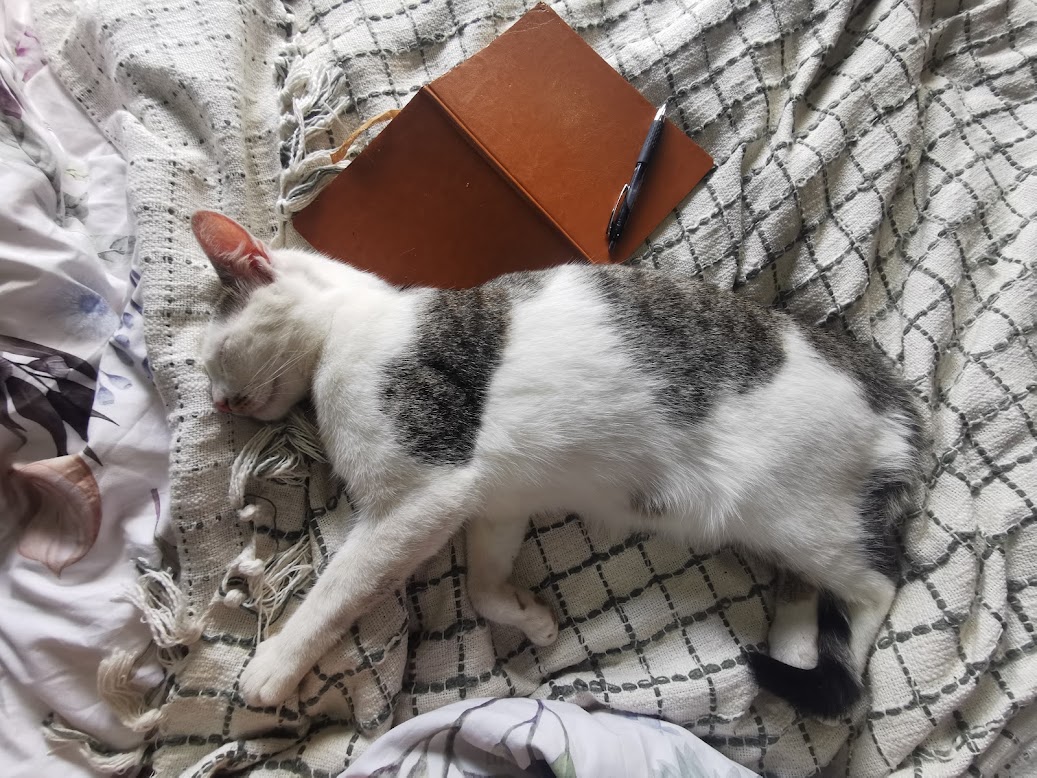
There are some days when life feels heavier than usual, although nothing obvious has happened. The washing still needs folding, emails continue arriving, supper has to be made and the world carries on exactly as it did yesterday. Yet somehow, everything feels just a little more difficult.
Those are often the days when I notice my cat watching me from across the room. He’ll stretch lazily, wander over without the slightest sense of urgency and settle beside me as though he has quietly decided that, for now, I shouldn’t have to be alone.
I’ve often laughed at the timing of it. He can ignore me for half the morning, disappearing into the garden or claiming the warmest patch of sunshine in the house as his own. But when my shoulders are tense or my thoughts seem to be racing in every direction, there he is. Not demanding food. Not looking for a game. Simply present.
It’s no wonder people call them therapy cats.
Not because they’ve been trained to offer comfort or because they understand every emotion we experience, but because they have an extraordinary way of making us feel less alone without saying a single word.
One of the things I admire most about cats is that they never seem interested in fixing us.
People, bless them, usually mean well. If we’re upset, they instinctively search for answers. They offer advice, remind us that things could be worse or assure us that tomorrow will be a better day. Sometimes that’s exactly what we need.
Other times, it’s exhausting.
There are moments when all we really want is permission to feel whatever we’re feeling without having to explain it. Cats seem to understand that instinctively. They don’t ask questions about why you’ve had a difficult day. They don’t expect conversation or cheerful smiles. If you want to sit quietly with a cup of tea staring out of the window while the rain taps gently against the glass, they’ll often sit there with you as though it’s the most natural thing in the world.
There’s something deeply comforting about that kind of companionship.
Perhaps that’s why so many people find themselves telling their cat things they’ve never told another person. Not because they expect advice in return, but because speaking out loud somehow lightens the load. The cat simply blinks slowly, flicks an ear or curls up a little closer, completely unconcerned by our tangled thoughts.
It’s acceptance in its purest form.
Almost every cat owner has a story that makes them wonder.
The cat that refused to leave an elderly owner’s bedside after an operation.
The normally independent tomcat who suddenly spent every evening on his owner’s lap during a particularly painful divorce.
The kitten that became unusually gentle around a child who was struggling with anxiety.
We smile at these stories because they sound almost too remarkable to believe, yet they’re shared in homes all over the world.
I’ve experienced it myself more than once. There have been days when grief or worry has quietly crept in, not loudly enough for anyone else to notice but enough to leave me feeling emotionally tired. Without fail, my cat has somehow sensed the change. Instead of demanding attention in his usual mischievous way, he’ll climb beside me, press himself against my arm and begin that wonderfully rhythmic purr that seems to vibrate through the whole room.
The remarkable thing is that nothing else has changed.
The problems are still waiting.
The difficult conversations still need to happen.
The laundry basket certainly hasn’t emptied itself.
Yet sitting there with a warm little body leaning gently against mine somehow makes the weight feel easier to carry.
Scientists have spent years studying the bond between humans and animals, and while there is still much to learn, research continues to show that spending time with pets can lower stress levels, reduce feelings of loneliness and even help lower blood pressure. Stroking a calm cat can encourage the release of oxytocin, often called the “bonding hormone”, while reducing cortisol, the hormone most closely associated with stress.
Those scientific explanations are fascinating, but I suspect most cat owners don’t need a research paper to convince them.
They’ve already lived it.
I sometimes think cats receive less credit than they deserve because they aren’t quite as demonstrative as dogs. Dogs wear their hearts on their sleeves. They greet us as though we’ve returned from an expedition every time we’ve been to put the bins out. Their enthusiasm is impossible not to love.
Cats are different.
Their affection is quieter, almost understated, which somehow makes it even more meaningful.
When a cat chooses to curl up beside you, rest a paw on your arm or sleep peacefully on your lap, it feels less like habit and more like trust. They’ve chosen your company, and somehow that small act carries an unexpected emotional weight.
Perhaps that’s why, during some of life’s most difficult seasons, so many people discover that their greatest comfort comes from a companion who can’t offer advice, solve problems or speak a single word.
Sometimes healing doesn’t begin with a conversation.
Sometimes it begins with the gentle rumble of a purr, a warm weight settling beside you and the comforting reminder that you don’t have to face everything on your own.
If cats excel at anything, besides finding the only clean pile of washing to sleep on, it’s reminding us that not every moment has to be productive.
We live in a culture that celebrates being busy. There always seems to be another errand to run, another message to answer or another job waiting patiently at the bottom of the list. Even when we finally sit down, many of us struggle to quieten our minds. We feel guilty for resting, as though doing nothing is somehow wasting precious time.
Cats have absolutely no interest in such nonsense.
They sleep when they’re tired. They stretch luxuriously when they wake. They bask in a patch of sunshine without the slightest concern that they could be doing something more useful. Watching them can be strangely liberating. They seem completely comfortable with the idea that rest isn’t something that has to be earned.
I think that’s one of the quiet lessons they teach us every day.
When a cat jumps onto your lap, you’re presented with a choice. You can continue rushing through your day, gently moving them aside as you hurry to the next task, or you can stay exactly where you are for another ten minutes, listening to that familiar purr while the world waits outside.
More often than not, those ten minutes are exactly what we needed.
I’ve lost count of the number of times I’ve stood up afterwards feeling calmer, even though nothing around me had changed. The list was still there. The house still needed attention. Life hadn’t miraculously sorted itself out while my cat was asleep across my knees.
What had changed was me.
Sometimes that’s enough.
People often describe cats as aloof, and I smile every time I hear it.
Independent? Absolutely.
Selective? Without question.
But emotionally distant? I don’t believe that for a second.
Cats simply express affection differently.
They don’t throw themselves at the front door every time we arrive home. Instead, they wander over with deliberate confidence, brushing against our legs before leading us towards the kitchen as though they’ve been waiting patiently all day. They’ll blink slowly from across the room, a gesture that cat behaviourists believe is a sign of trust. They’ll choose to sleep with their back against your leg because they feel safe enough to let their guard down.
To anyone who has never shared life with a cat, these moments may seem insignificant.
To those of us who have, they speak volumes.
There’s something rather beautiful about earning the trust of an animal that never gives it away lightly. Every head bump, every gentle purr and every evening spent curled beside us feels like a decision they’ve made rather than an obligation.
Perhaps that’s why losing a cat can leave such a profound ache.
They quietly weave themselves into the ordinary rhythm of our lives until we can no longer imagine the house without the gentle sound of paws padding down the passage or the familiar shape asleep in their favourite chair.
It’s never just the pet we miss.
It’s the comforting routine.
The silent companionship.
The little soul who somehow knew exactly where we needed them to be.
I’ve spoken to people who were recovering from surgery, grieving the loss of a loved one or simply feeling overwhelmed by life’s relentless demands, and so many of them tell remarkably similar stories.
Their cat refused to leave their side.
One friend laughed as she told me that her usually independent tabby, who normally considered cuddles beneath his dignity, spent almost two weeks sleeping beside her after she came home from hospital. Every time she settled into bed, there he was, curled tightly against her legs as though he’d quietly appointed himself head nurse.
Another friend lost her husband after more than forty years of marriage. During those first lonely months, when the evenings felt impossibly long, her elderly cat developed a new habit. Every night, just as she sat down with her cup of tea, he climbed onto the arm of the chair, rested one paw gently on her shoulder and remained there until she went to bed.
Neither cat understood the details of what had happened.
They didn’t need to.
They recognised that someone they loved wasn’t quite themselves.
Sometimes I think that’s where animals have an advantage over us. They don’t become distracted by explanations, opinions or awkward conversations. They respond to what they see in front of them. A slower walk. Quieter footsteps. Tears that come unexpectedly. Long periods of silence.
Their response is beautifully uncomplicated.
“I’m here.”
How often do we long for exactly that from the people around us?
Not solutions.
Not advice.
Simply someone willing to stay close until the storm passes.
It may seem extraordinary that such comfort can come wrapped in fur, whiskers and an occasional hairball left in the most inconvenient place imaginable.
Yet anyone who has loved a cat knows that some of life’s greatest comforts arrive in the simplest forms.
Perhaps one of the greatest misconceptions about cats is that they are selfish creatures, interested only in food, warmth and finding the most inconvenient place possible to sleep. Anyone who has shared their home with one knows the truth is far more complicated.
Cats don’t wear their emotions on the outside.
Instead, they express love in quiet, almost understated ways. They greet us with a soft chirrup from another room. They brush gently against our legs as we make the morning coffee. They wait patiently on the windowsill for us to return home. They choose to sleep on our bed, not because they have nowhere else to go, but because, out of every comfortable place in the house, they’ve decided ours is where they want to be.
There’s something rather beautiful about affection that isn’t showy.
It reminds me of the people in our lives who rarely make grand gestures but are always there when it matters. The friend who arrives with a homemade meal after a difficult week. The neighbour who quietly cuts your grass when you’ve been unwell. The family member who simply sits beside you when words aren’t enough.
Real love often whispers.
Cats seem to understand that instinctively.
If only we could see ourselves through the eyes of a cat.
They don’t worry about the email they forgot to send yesterday or spend Sunday afternoon imagining everything that could go wrong next week. They aren’t comparing themselves to the cat next door or wondering whether they’re successful enough.
Their world is wonderfully uncomplicated.
A sunny windowsill.
A favourite blanket.
Fresh water.
Someone they trust.
A butterfly fluttering past the garden gate.
It sounds almost too simple, yet perhaps that’s exactly why spending time with cats can be so calming. They gently draw our attention back to the present moment without even trying. While we sit stroking their soft fur, listening to that steady rhythm of their purring, our breathing slows almost without us noticing. For a little while, the endless list inside our heads becomes less urgent.
I’ve often thought that cats have mastered something many of us spend years trying to learn.
How to be fully present.
Not because they’ve read books about mindfulness or attended wellness retreats, but because that’s simply how they experience life.
Watching them reminds me that happiness is very often found in ordinary moments we rush past every day.
The warmth of afternoon sunshine spilling across the lounge floor.
The comforting smell of fresh coffee drifting through the kitchen.
The sound of rain tapping softly against the windows while a cat sleeps peacefully beside us.
None of these moments changes the world.
Yet they have a remarkable way of changing us.
I don’t believe cats possess magical powers.
They can’t remove grief, erase anxiety or solve the complicated problems that life occasionally places in our path.
But I do believe they have a quiet gift.
They help us carry those burdens.
When we’ve had one of those days that leaves us emotionally exhausted, they ask nothing more than a warm lap or a place beside us on the sofa. They don’t care whether we’ve had a productive day, whether the house is spotless or whether we’ve managed to tick everything off our endless to-do list.
To them, we’re enough exactly as we are.
What an extraordinary thing that is.
Perhaps that’s why so many therapists, hospitals, nursing homes and care facilities now include animals as part of emotional support programmes. It’s not because animals replace medical care or professional counselling. It’s because they offer something wonderfully different.
They offer connection.
They remind people who may be feeling isolated, frightened or overwhelmed that comfort doesn’t always arrive through conversation. Sometimes it arrives through simple companionship, steady routine and the reassuring presence of another living being.
Cats seem particularly gifted at this.
They never rush us towards feeling better.
They simply stay close until we do.
As I write this, my own cat is asleep nearby, completely unaware that he’s become the inspiration for today’s thoughts. If he were awake, he’d probably be trying to persuade me that dinner should be served several hours early or investigating a cupboard he has absolutely no business climbing into.
Life with cats isn’t always peaceful.
They knock ornaments off shelves for reasons known only to themselves. They leave fur on freshly washed clothes. They race through the house at two o’clock in the morning as though invisible monsters are giving chase. They somehow manage to look deeply offended when we’ve accidentally sat in their chair.
And yet, we wouldn’t change them.
Those little quirks become part of the rhythm of family life, woven into our memories almost without us noticing. Years later, it’s often these ordinary moments that return to us first. The gentle purring beside us while we read a book. The warm weight on our lap during a winter evening. The familiar face waiting patiently at the window when we came home.
Perhaps that’s the real reason they call them therapy cats.
Not because they have all the answers.
Not because they make sadness disappear.
But because, in a world that often feels noisy, demanding and complicated, they quietly remind us what comfort really looks like.
Sometimes it’s nothing more than a soft purr, a trusting glance and the comforting knowledge that, whatever today has brought, someone is perfectly content just being close to us.
And somehow, that’s enough.
Not always. While some therapy cats are trained to visit hospitals, nursing homes and care facilities, many people use the phrase “therapy cat” to describe the emotional comfort their own pet provides at home through companionship and affection.
Many studies suggest that spending time with a calm cat may help lower stress levels, reduce blood pressure and encourage relaxation. Even a few quiet minutes stroking a purring cat can help many people feel calmer.
Although researchers are still learning more about feline behaviour, cats are excellent observers. They notice changes in our routines, body language, tone of voice and activity levels, often responding by staying close to us.
For many people, yes. Cats provide companionship, routine and unconditional acceptance, all of which can make living alone feel much less isolating.
A cat’s purr produces gentle, low-frequency vibrations that many people find relaxing. Combined with the soothing rhythm of stroking a cat, it can create a strong sense of calm and emotional wellbeing.
Cats can make wonderful companions for older adults. Many breeds require relatively little maintenance, enjoy a peaceful home environment and provide affection without demanding constant attention.
After spending time reflecting on the comfort our pets bring, you might also enjoy these Rustic Daisy articles that celebrate the quieter moments in life and the relationships that help us through life’s changing seasons.
The Meals I Cook When Life Feels Too Heavy To Think
Creating A Cosy Home After a Major Life Transition
The Unexpected Joy Of Growing Herbs At Home
Things Elderly Parents Need That Money Can’t Buy
Living Large In A Tiny Space: Memories That Last A Lifetime
Thank you for spending a little time with me here at Rustic Daisy. I hope this story reminded you to slow down, notice the quiet comforts around you and appreciate the little companions who ask for so little while giving us so much. Whether you’re sharing your home with a mischievous kitten, a dignified old gentleman cat or simply carrying the memory of one who once filled your days with purrs, I hope you’ll visit again soon. There’s always another story waiting, and the kettle is always on.
With love