

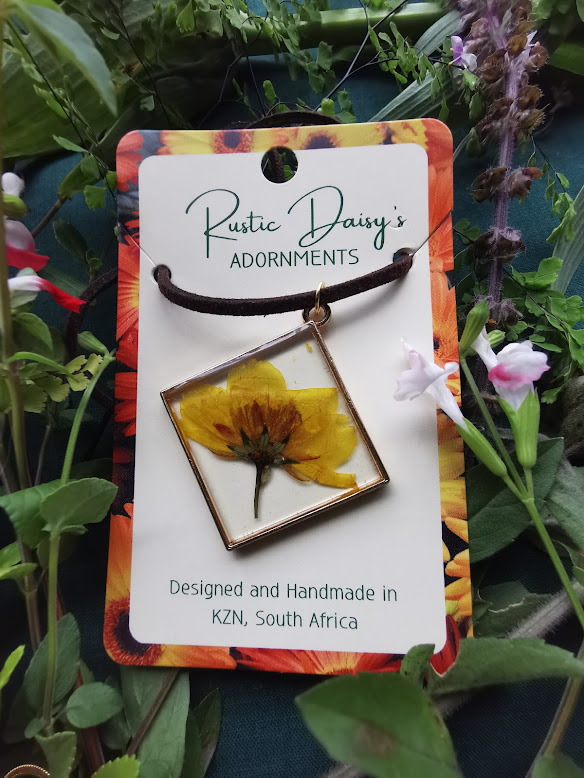
There is something almost magical about holding a piece of resin jewellery up to the light and watching tiny flowers, delicate leaves or shimmering flecks appear to float inside it. A simple pendant can contain a pressed flower, a little piece of lace, a shell collected beside the sea or a colour combination that exists nowhere else. What begins as a few carefully chosen materials can become something personal and surprisingly beautiful, and I think that is part of the reason resin jewellery has become such an appealing craft for people who might never have thought of themselves as particularly artistic.
I have always been drawn to crafts that allow us to take ordinary things and turn them into something worth keeping and that is why I started making resin jewellery. There is something particularly satisfying about preserving a tiny piece of nature or a meaningful little object and giving it a completely new purpose. A dried flower that might otherwise have been forgotten in a drawer can become a pendant, while a few tiny shells collected during a family holiday can become earrings that bring back a happy memory every time you wear them.
What I particularly love about resin jewellery, though, is that you don’t have to be an artist to begin. You don’t need a dedicated craft room, years of experience or an enormous collection of expensive equipment. You need a few sensible supplies, a suitable workspace, patience and a willingness to learn from the occasional little disaster. And believe me, there will probably be a few disasters along the way. Resin has a wonderfully mischievous habit of producing bubbles, moving flowers that were perfectly positioned five minutes earlier and creating what I like to call unexpected design features.
The good news is that those early mistakes are part of learning. Your first piece doesn’t need to be perfect, and it certainly doesn’t need to look like something from a professional jewellery shop. It simply needs to teach you something. So, if you’ve been admiring resin jewellery and wondering whether you could make something similar at home, let’s look at what you actually need to get started, how to choose your first supplies and what you should know before you make your first pour.
A quick note before we begin: Some of the links in this article are affiliate links. This means that if you choose to make a purchase through one of them, I may earn a small commission at no additional cost to you. I only recommend products that I believe can be genuinely useful for the projects I am discussing. As a South African reader, please remember that Amazon is an international marketplace, so shipping, import charges and delivery costs may apply. I am continually looking for good South African alternatives as well, because I know that ordering from overseas isn’t always practical.
Yes, but I think it helps to approach it with realistic expectations.
Resin jewellery isn’t necessarily difficult, but it does involve a few processes where accuracy and patience matter. Different resin products have different instructions for mixing, handling, curing and recommended thicknesses, so the first rule is to read the instructions supplied with the particular product you have bought rather than assuming that all resin behaves in exactly the same way.
Once you understand those basics, however, making small jewellery pieces becomes much less intimidating. You can start with something very simple, such as a small pendant containing one or two dried flowers, rather than immediately attempting an elaborate layered necklace with twelve colours, glitter, gold leaf and enough decorative elements to stock a craft shop.
I completely understand the temptation, though.
Spend five minutes looking at resin moulds, pigments, dried flowers, glitter, charms and jewellery findings online and suddenly it seems entirely reasonable to own enough craft supplies to open a small business from the spare bedroom.
The sensible approach is to start small. Choose one resin system, a few simple moulds and a small selection of decorative materials. Learn how the resin behaves before you spend a fortune experimenting with every technique you have seen on Pinterest.
There is something rather lovely about starting that way. Your first pendant doesn’t have to become a masterpiece. It simply needs to teach you something.
The wonderful thing about making resin jewellery at home is that the basic equipment list is shorter than it first appears. You don’t need every tool available on the market, and you certainly don’t need a professional jewellery studio before you’ve made your first piece.
Start with the essentials and add things as you discover what you enjoy making.
The most obvious place to start is the resin itself, but this is also one of the areas where beginners can become confused because there are different types of resin designed for different purposes.
Two-part epoxy resin generally comes as resin and hardener, which are combined according to the manufacturer’s specified ratio before use. UV resin is a different type of product and is cured using a suitable UV or UV-LED light.
Neither is automatically the “best” resin. The right choice depends on the type of jewellery you want to make, the moulds you are using, the thickness of the finished piece and the instructions supplied with the product.
For your first projects, I would keep things simple and choose one resin system rather than buying several different types at once. Learn how that particular product behaves before adding another one to your collection.
A clear resin can be especially lovely for botanical jewellery because it allows flowers, leaves and other inclusions to remain the focus of the design.
Silicone moulds are what give your resin its shape, and this is where things become wonderfully tempting because there are an enormous number of shapes available.
You can find moulds for pendants, earrings, rings, charms and all sorts of decorative pieces. There are simple geometric shapes, flowers, hearts, ovals, teardrops and elaborate designs that make you want to buy the entire collection immediately.
Resist the urge.
For a complete beginner, a few simple shapes are more than enough. Smaller geometric or straightforward pendant shapes allow you to concentrate on learning how to work with the resin rather than trying to manage an overly complicated design.
There is also something wonderfully satisfying about removing a piece from its mould for the first time. You spend all that time wondering what is happening underneath the shiny surface, and then you finally flex the silicone and see what you’ve actually made.
Sometimes it is beautiful.
Sometimes it is educational.
Both outcomes count.
Good measuring and mixing equipment is one of those things that doesn’t sound particularly exciting until you discover how much frustration it can prevent.
Depending on your chosen resin system, you may need suitable measuring cups, mixing cups and stirring tools. Always follow the instructions supplied with your resin rather than assuming that every product is measured or mixed in exactly the same way.
Small disposable tools can also be useful when you are working with tiny jewellery moulds or adding small amounts of colour. Fine tweezers are particularly handy for positioning delicate flowers, leaves and other small decorative elements without disturbing everything around them.
You don’t need a drawer full of specialist tools when you begin. A small collection of sensible equipment is plenty.
This is one area where I don’t think it is worth trying to save money.
When working with uncured resin, use suitable protective gloves and follow the safety instructions supplied with your particular product. Your work surface should also be protected so that accidental spills don’t become permanent decorations on your dining table.
A silicone craft mat can be particularly useful because it gives you a protected surface while also making small spills and drips much easier to deal with.
And please don’t use food-preparation surfaces, bowls or utensils for resin crafting. Keeping your craft equipment separate from anything used for cooking is a very sensible habit from the beginning.
This is one of the first decisions you’ll come across when you start researching resin jewellery, and it is worth understanding the difference.
Two-part epoxy resin uses resin and hardener that are combined according to the manufacturer’s instructions. Once mixed, the material cures through a chemical reaction. It can be useful for projects where you want to create layers or work with pieces that are deeper or larger, depending on the specific product.
UV resin comes ready to use and cures when exposed to a compatible UV or UV-LED light. It can be convenient for smaller projects and certain jewellery techniques because you control when curing begins by exposing the resin to the appropriate light.
The important thing is not to think of one as universally better than the other.
Think about what you actually want to make.
If you are interested in small, delicate pieces and like the idea of working in thin layers, UV resin may appeal to you. If you want to experiment with deeper moulds, layered designs or larger pieces, a suitable two-part epoxy may be more appropriate.
Whichever you choose, read the manufacturer’s instructions carefully. Pay particular attention to mixing ratios where applicable, recommended layer thickness, curing requirements, working time and safety information.
And if you are anything like me, you will eventually end up with several bottles of resin in your cupboard labelled mentally as “the one I’m experimenting with”.
I say this with absolutely no judgement.
This is probably my favourite part because this is where resin jewellery becomes truly personal.
Dried flowers can look absolutely beautiful suspended in clear resin. Tiny daisies, delicate petals, small leaves and fern-like pieces can create wonderfully botanical designs, while mica powders, metallic flakes and carefully chosen colours can create something much more dramatic.
You can also experiment with other suitable decorative elements, including tiny shells, glitter, charms, beads and decorative foils.
But there is an important lesson here for beginners: anything you place inside resin needs to be properly prepared and suitable for use with the material.
Fresh flowers are not simply the same thing as dried flowers. Plant material contains moisture, and moisture can affect resin projects, so botanical inclusions should be properly dried before you attempt to preserve them in resin.
This is one of the reasons I think botanical resin jewellery can be such a lovely craft. The project doesn’t necessarily begin when you open your bottle of resin. It may begin much earlier, when you choose a flower, press it carefully and wait for it to become ready.
A tiny flower from the garden can become part of something you keep for years.
That makes the finished jewellery feel rather special.
You don’t need a Pinterest-perfect craft room to make resin jewellery.
A small, organised workspace can be perfectly adequate, provided it is suitable for the resin you are using and gives you enough room to work safely. Your surface should be stable and protected, and you need somewhere appropriate for your pieces to remain undisturbed while they cure.
That last part is more important than it sounds.
Resin pieces need to be protected from curious fingers, accidental knocks, dust and anything else that might interfere with them while they are curing. If you have children or pets, make sure your workspace and curing pieces are somewhere they cannot accidentally investigate.
Anyone who has ever owned a curious cat will understand this immediately.
You can spend half an hour carefully positioning a tiny flower, only to discover that someone has decided your carefully prepared mould looks like an interesting new object that needs investigating.
Suddenly your perfectly centred flower is no longer centred.
A little planning saves a lot of frustration.
It is also worth keeping your resin supplies together in one place. A small storage box or drawer can prevent your workspace from gradually turning into a collection of moulds, bottles, bags and mysterious little packets that you no longer remember buying.
I know safety isn’t the most exciting part of a creative article, but this is one area where I would rather be boring than sorry.
Always read and follow the safety instructions supplied with your particular resin. Work in an appropriately ventilated area, avoid getting uncured resin on your skin or in your eyes, and use the protective equipment recommended by the manufacturer and safety information for the product you are using.
Keep uncured resin and resin-making equipment away from children and pets, and make sure that your workspace is not somewhere food is prepared.
If your particular product’s safety information recommends additional respiratory protection, follow that guidance rather than assuming that every resin product has identical requirements.
It is also important to distinguish between uncured and fully cured resin. Don’t treat a piece as ready to handle simply because it looks hard on the surface. Follow the manufacturer’s curing instructions and allow the piece to cure properly before sanding, assembling or wearing it.
The same principle applies to sanding. Only work on resin that is fully cured, and use appropriate precautions for the dust created during finishing.
Resin is a wonderful material to work with, but it deserves to be treated as a craft material rather than something completely harmless just because it comes in a pretty little bottle.
Once you understand the basics, there are a few things that can make getting started considerably easier. I have deliberately kept this list short because I don’t think beginners need to buy an entire craft shop before making their first piece.
If botanical jewellery is what attracted you to resin in the first place, a good selection of pressed flowers can give you plenty of creative possibilities without having to wait for flowers from your own garden to dry.
See the pressed flower kit I found here
Tiny flowers and leaves can completely change the character of a simple pendant, and having several varieties available makes it easier to experiment with different combinations.
A protected work surface is one of those practical purchases that you may not appreciate until you are trying to clean resin from the table.
See the silicone craft mat here
It gives you a dedicated surface for your crafting and can make cleaning up after a project considerably less stressful.
If you decide to experiment with UV resin, you will need a suitable curing light that is compatible with the resin you are using.
See the UV resin curing light here
Always check that the light and resin are compatible and follow the curing instructions supplied with your particular product.
Once you have created the resin component, you will eventually need jewellery findings and other little pieces to turn it into something wearable.
See the jewellery-making supplies here
Having a selection of basic findings available means you can experiment with turning the same type of resin piece into a pendant, earrings or another small accessory.
Clear resin is beautiful, particularly when you are working with flowers, but colour opens up an entirely different world of possibilities.
A tiny amount of colour can change the whole mood of a piece, from soft and subtle to bright and dramatic. Start with small amounts and experiment rather than trying to create intensely coloured resin immediately.
If there is one thing I would encourage a new resin jewellery maker to remember, it is this: you don’t need to buy everything before you begin.
It is very easy to become overwhelmed by the sheer number of beautiful supplies available. There are moulds, pigments, flowers, glitter, foils, charms, tools, findings and enough different varieties of resin to make your head spin.
But you don’t need them all.
Start with a simple mould, one suitable resin system, basic protective equipment, a few decorative elements and enough jewellery findings to turn your first pieces into something wearable.
Once you’ve made a few projects, you’ll naturally discover what you enjoy.
Perhaps you will fall in love with botanical pendants. Perhaps earrings will become your thing. Maybe you’ll discover that you prefer colourful abstract pieces rather than flowers at all.
That is the fun of learning.
You don’t have to know your style before you start making.
You discover it along the way.
My advice would be to make something small and uncomplicated.
A simple pendant is a lovely first project because it allows you to learn about your resin without requiring an enormous amount of material. You can concentrate on positioning one or two flowers, getting comfortable with your chosen resin and seeing how the finished piece behaves.
Don’t start with the most complicated project you’ve ever seen online simply because it looks beautiful.
Remember that the person who made it may have been working with resin for years.
There is nothing wrong with beginning with something simple.
In fact, I think there is something wonderfully satisfying about watching your skills develop gradually. The first piece teaches you how the resin behaves. The second teaches you something else. By the time you’ve made your tenth, you may look back at the first one and laugh at all the things you would now do differently.
That isn’t failure.
That’s progress.
One of the lovely things about resin jewellery is that it can become much more than a relaxing craft.
Once you become comfortable with the basics, handmade resin jewellery can make wonderfully personal gifts. You can choose colours to suit someone’s personality, preserve tiny botanical elements or create a piece that reminds someone of a particular place or occasion.
And because every piece is made individually, there will always be tiny differences between them.
That is part of the charm.
A handmade gift doesn’t need to be expensive to be meaningful. Sometimes the fact that somebody spent time making something rather than simply clicking “add to basket” is what makes it special.
It certainly can, although I would encourage you to think about this only after you’ve had time to learn the craft properly.
There is a big difference between making a few pretty pieces for yourself and producing jewellery consistently enough that other people are willing to pay for it.
Before thinking about selling, you need to become comfortable with your materials, your finishing techniques, your designs and the consistency of your results. You also need to understand the requirements that apply to selling handmade products where you live.
The wonderful thing is that you don’t need to make that decision on day one.
Start because you enjoy it.
Learn because you are curious.
And if, somewhere along the way, people start asking where they can buy the jewellery you’ve made, perhaps you have discovered the beginning of something rather special.
By now, you should have a much clearer idea of what you need before you start making resin jewellery at home.
You don’t need a huge collection of supplies, an expensive studio or years of artistic experience. You need a suitable resin, a few basic tools, appropriate safety equipment, somewhere sensible to work and a little patience.
Most importantly, you need permission to be a beginner.
Your first piece may have a bubble in it. A flower may move. Your colour may not turn out quite the way you imagined. You may discover that the beautiful technique you watched online requires considerably more patience than the five-minute video suggested.
That’s all part of it.
The beauty of resin jewellery isn’t simply in the finished pendant or pair of earrings. It is in the process of taking a handful of ordinary materials and turning them into something that didn’t exist before.
There is something wonderfully satisfying about making things with your own hands.
Perhaps that’s why I keep coming back to crafts. In a world where so much can be ordered, downloaded, streamed or delivered to the front door, there is still something special about sitting down with a few simple materials and making something yourself.
Resin jewellery gives you the opportunity to capture tiny pieces of beauty and turn them into something you can wear, give away or simply keep.
And if your first attempt isn’t perfect, don’t throw it away too quickly.
It might just be the piece that teaches you everything you needed to know.
If you’re enjoying the creative side of making things yourself, you might also like these Rustic Daisy articles:
Simple Craft Ideas For People Who Think They Are Not Creative
Easy ideas for getting creative without feeling that you need to be naturally artistic.
Why Handmade Gifts Mean So Much More Than Store-Bought Presents
There is something special about giving a gift that has taken time, thought and a little bit of yourself to make.
Creative Craft Room Storage Ideas For Small Spaces
Because once you discover a new craft, the supplies have a funny way of multiplying!
Until next time,
Sharon 🌼