

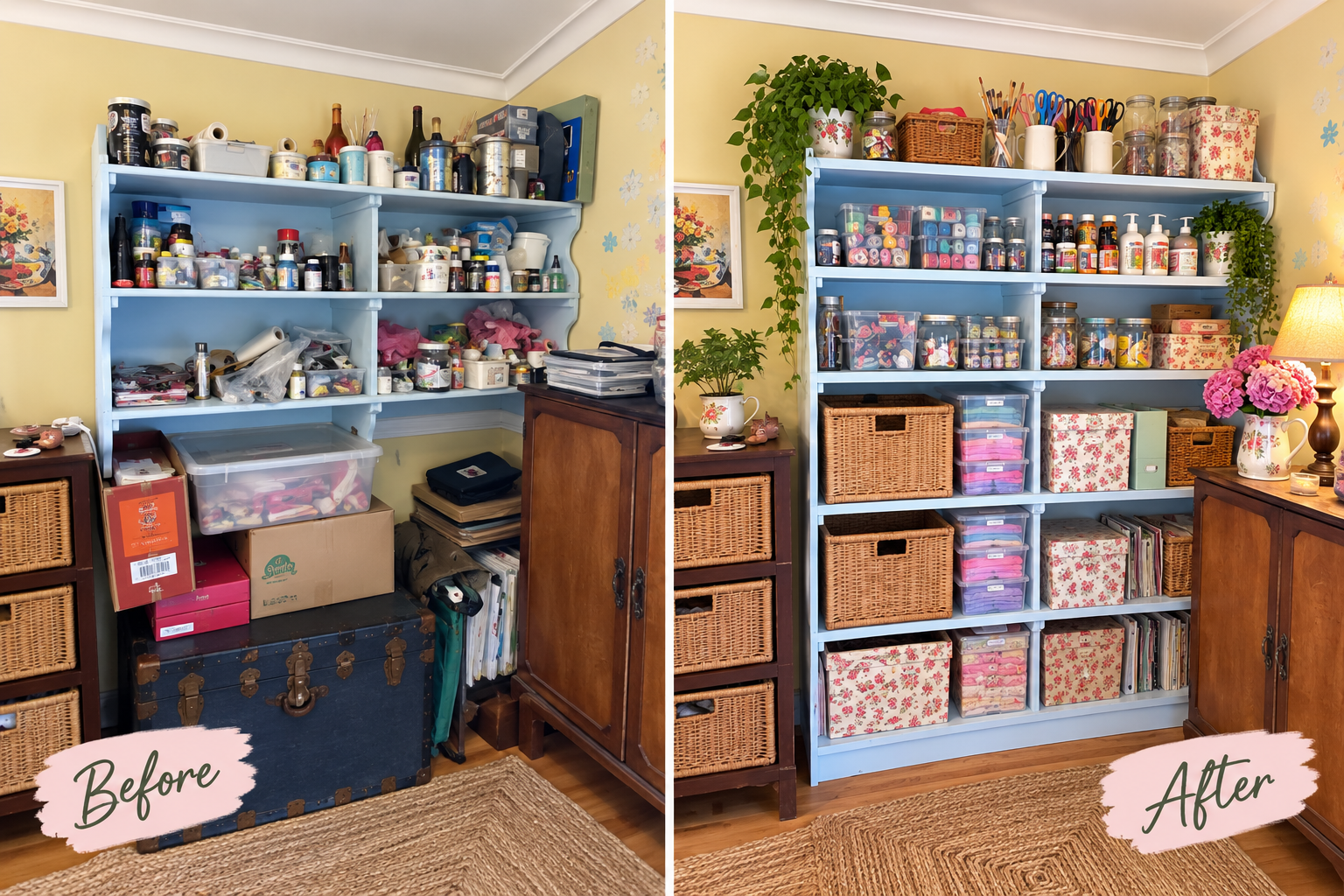
I used to believe that having a proper craft room meant having an entire spare bedroom filled with beautiful shelves, matching storage containers and endless work surfaces.
Then reality stepped in and I came up with some creative craft room storage ideas to make my life a bit easier.
Like many people, I found myself trying to fit my creative hobbies into a small corner of my home. Supplies seemed to multiply overnight. Ribbon tangled itself into impossible knots. Paper stacks developed a life of their own. Paints disappeared precisely when I needed them and somehow I ended up buying duplicates because I couldn’t find what I already owned.
If you love crafting but don’t have a large dedicated space, you are certainly not alone.
The good news is that a small craft area can be every bit as functional and inspiring as a large one. In fact, working within limited space often encourages us to become more organised and creative with storage solutions.
Over time I have experimented with countless storage ideas. Some worked brilliantly. Others looked wonderful in photographs but were completely impractical in everyday life.
These are the storage solutions that genuinely make crafting easier whilst helping a small space feel tidy, welcoming and inspiring.
A cluttered craft area can quickly become overwhelming.
When supplies are difficult to find, projects take longer and frustration often replaces enjoyment. I have abandoned more than one creative idea simply because I could not face searching through piles of materials.
Even a very small crafting corner can feel surprisingly spacious when everything has a designated home.
One of the biggest mistakes I made in my early crafting days was focusing only on floor space and desk space.
The walls above your workspace are often the most valuable storage area available. Wall-mounted shelves can hold baskets, jars, books, paints and decorative supplies without taking up precious room. It also makes all your bits and pieces visible.
Pegboards are another fantastic solution. They can be customised with hooks, small shelves and containers to store scissors, rulers, ribbons and tools.
Using vertical storage allows you to keep frequently used items visible and accessible whilst maintaining a tidy work surface.
I cannot overstate how helpful clear storage containers have been in my own craft area. When supplies are hidden inside opaque boxes, no matter how well labeled, it becomes surprisingly easy to forget what you own.
Transparent containers allow you to see contents immediately.
Labelling each container can provide an additional layer of organisation but, for me at least, being able to glance over the containers and see what I have available helps tremendously.
Some of my favourite storage solutions cost almost nothing.
Repurposing household items adds character to a craft room whilst helping keep costs under control.
Not everyone has the luxury of leaving projects set up permanently. If your dining table doubles as your crafting space, mobility becomes essential.
A rolling trolley can be a game changer. Everything you need can be stored in one place and moved wherever you choose to work. When crafting time is over, simply wheel the trolley away.
Many crafters find that a mobile station dramatically increases the amount of time they spend enjoying their hobbies.
Cupboard doors are often overlooked. The inside of a cupboard door can become a valuable storage area. Over-the-door organisers designed for shoes can hold countless craft supplies including:
This simple solution keeps items visible without creating additional clutter.
Drawers can quickly become chaotic. Without dividers, supplies shift around every time a drawer opens or closes. Simple drawer organisers help create dedicated sections for different materials.
Opening a neatly organised drawer instantly creates a sense of calm and efficiency.
Paper crafting supplies can consume enormous amounts of space.
Stacking paper horizontally often results in untidy piles that are difficult to browse.
Vertical storage is far more practical.
Magazine boxes, document holders and paper racks allow you to sort papers by colour, theme or project type. I like to use a ring binder with plastic sleeves in it for my decoupage serviettes and cut outs.
These methods protect paper from damage and moisture whilst making it easier to locate exactly what you need.
Some craft supplies are simply too beautiful to hide away.
Colourful ribbons, yarns, buttons and fabrics can become decorative features within the room. Open shelving provides an opportunity to combine storage with visual appeal.
A functional craft room does not have to look purely practical.
One of the most useful organisational habits I have adopted is storing supplies by project. Instead of keeping all materials separated by category, I often create containers for specific projects.
When inspiration strikes I can simply grab the appropriate container and everything I need will be there for me to begin working immediately.
In small spaces every centimetre counts so stackable containers allow you to build upward rather than outward. Many modern storage systems are designed specifically for crafters and can be adjusted as your collection grows.
The flexibility makes it easy to adapt your organisation system over time.
Not every item deserves prime storage space. Supplies you use daily should be more accessible than items used only occasionally. These can be stored higher up or further away.
I keep my most frequently used tools close to my work area. This simple adjustment reduces interruptions and helps projects flow more smoothly.
Besides the space you need whilst sitting at your craft desk, the space on either side of you is often underutilised.
Rolling drawers, baskets and storage containers fit neatly underneath work surfaces. These hidden storage areas are perfect for larger items that do not need to remain visible.
Making use of this forgotten space can significantly increase storage capacity.
Many crafters collect materials for different times of year.
Christmas ribbons, Easter embellishments and autumn decorations do not need to occupy valuable everyday space all year round. Seasonal rotation keeps your main storage area manageable.
Store off-season supplies in clearly labelled containers in the garage, attic or outside shed and swap them as needed. This prevents overcrowding and makes it easier to locate relevant materials.
One lesson I learned the hard way is that organisation cannot solve over-accumulation. Before investing in storage systems, spend time sorting through supplies.
Donating unused materials can create valuable space whilst helping fellow crafters.
A smaller collection that you genuinely use is often far more enjoyable than an overwhelming one.
Storage is not only about organisation. Your craft area should also feel welcoming.
A few personal touches can make a remarkable difference.
These small details help transform a storage area into a creative retreat and, for me, they often spark creative ideas.
When a space feels inviting, we naturally spend more time enjoying it.
Some of the most beautiful handmade projects I have ever created came from a tiny corner of my home.
Creativity does not depend on the size of a room. It flourishes when supplies are accessible, inspiration is close at hand and the environment feels comfortable.
A thoughtfully organised craft space removes barriers and makes it easier to begin.
Whether you have an entire room, a cupboard, a spare corner or a mobile trolley, there are countless ways to create a functional and inspiring crafting area.
Sometimes the most creative storage solutions emerge when space is limited. A small craft room can become a place where ideas grow, projects come to life and everyday stresses fade into the background for a little while.
Once you start looking at your craft supplies differently, you may find that you don’t need nearly as much storage as you once thought. A few well-chosen pieces can make a surprisingly big difference, particularly when you’re working with limited space. I’ve gathered some of the storage ideas and products below that I think are worth considering if you’re looking for practical ways to keep your supplies organised without allowing them to take over your home.
You certainly don’t need to buy everything on the list, and you may already have perfectly good alternatives around the house. Think of these as ideas and inspiration rather than a shopping list. Sometimes one simple basket, trolley or set of containers is all it takes to make a small crafting area feel much easier to live with.
🌿 A little note about my Amazon links
Some of the products I recommend on Rustic Daisy are linked to Amazon. These are affiliate links, which means that if you choose to purchase something through one of my links, I may receive a small commission at no additional cost to you. This helps support Rustic Daisy and allows me to continue creating useful content for you.
As an Amazon Associate I earn from qualifying purchases.
A quick note for my lovely South African readers 🇿🇦
Amazon links can be useful for readers who already shop through Amazon in their own country. Unfortunately, there isn’t currently a South African Amazon shopping site, so international shipping charges, import duties or other fees may apply when ordering from Amazon.
These additional costs can sometimes make an otherwise reasonably priced product considerably more expensive, so please check the final price, delivery costs and any additional charges before placing your order.
I’m working on finding local alternatives! 🌿
I’m making a real effort to find similar products that are available right here in South Africa. Wherever I can find a good local alternative, I’ll share it with you so that South African readers have more affordable and practical options.
I only recommend products that I genuinely believe are useful, relevant and worth considering. I’m not here to fill my pages with links simply for the sake of earning a commission.
Thank you for supporting Rustic Daisy, whether you’re reading from South Africa or somewhere else in the world. Every visit, share, click and purchase helps my little corner of the internet continue to grow. 🌼
South African readers: your local alternatives are coming! 🇿🇦🌿
Rolling craft storage trolley – This storage cart is perfect for keeping your space tidy and organised. Great for crafting
Clear storage bins with lids – Being able to see what’s inside makes it much easier to stay organised.
Pegboard wall organiser – This peg board is great for organising all your essentials!
Craft storage drawers – I love this drawer organiser! All your craft supplies neatly organised.
Label Maker – Perfect for labelling storage boxes
Glass jars with lids – I love these for craft supplies
Scrapbook paper organiser – Got a lot of paper to sort? This organiser is a game changer!
Adjustable shelving units – Need extra storage? This sturdy shelving unit is perfect for any room.
Craft tool organiser – This 3-layer storage box is perfect for organising your craft tools.
Photo storage box – These photo boxes are great for keeping dried flowers and paper away from moisture
If you enjoy making things but are working with a small space, you might find that a little organisation opens the door to even more creative possibilities. Once everything has a place, it becomes much easier to sit down and actually enjoy a project rather than spending half your time looking for the scissors, the glue or that particular piece of ribbon you know is somewhere in the house.
I’ve gathered a few more Rustic Daisy articles below that you might enjoy. Some are about crafting, while others wander into the wider pleasures of making a home feel comfortable, useful and personal. Have a little look around — you never know which idea might inspire your next project.
Fun Easy Craft Ideas for older adults
Simple Craft Ideas for People Who Think They Are Not Creative
25 Things You Can Declutter Today Without Regret
The Unexpected Joy of Growing Herbs at Home
Why making resin jewellery has become therapy for me
I don’t think we need a perfect craft room to enjoy making things. In fact, some of the most satisfying creative spaces are the little corners we have managed to carve out amongst everything else that life requires of us.
A kitchen table that gets cleared at the end of the afternoon, a small cupboard filled with carefully sorted supplies or a trolley that can be rolled into a corner when you’re finished can be more than enough. What matters isn’t how much space you have, but whether that space makes you want to sit down and create something.
And perhaps that’s the real secret to organising a small craft space. It isn’t about fitting more things into less room. It’s about keeping the things you genuinely enjoy using close at hand, letting go of what you no longer need and making your little corner of the house feel welcoming enough that you actually want to spend time there.
So don’t worry if you don’t have the beautiful craft room you’ve seen in photographs. You don’t need one. Start with the space you have, make it work for you and change things gradually as you discover what you really need.
A small space can still hold a great deal of creativity.
With love,
Sharon 🌿
Thank you for spending a little time with me here at Rustic Daisy. I hope you’ve found a few ideas that will make your crafting space feel a little calmer, a little more organised and, most importantly, somewhere you enjoy being.
Until next time, happy creating.